
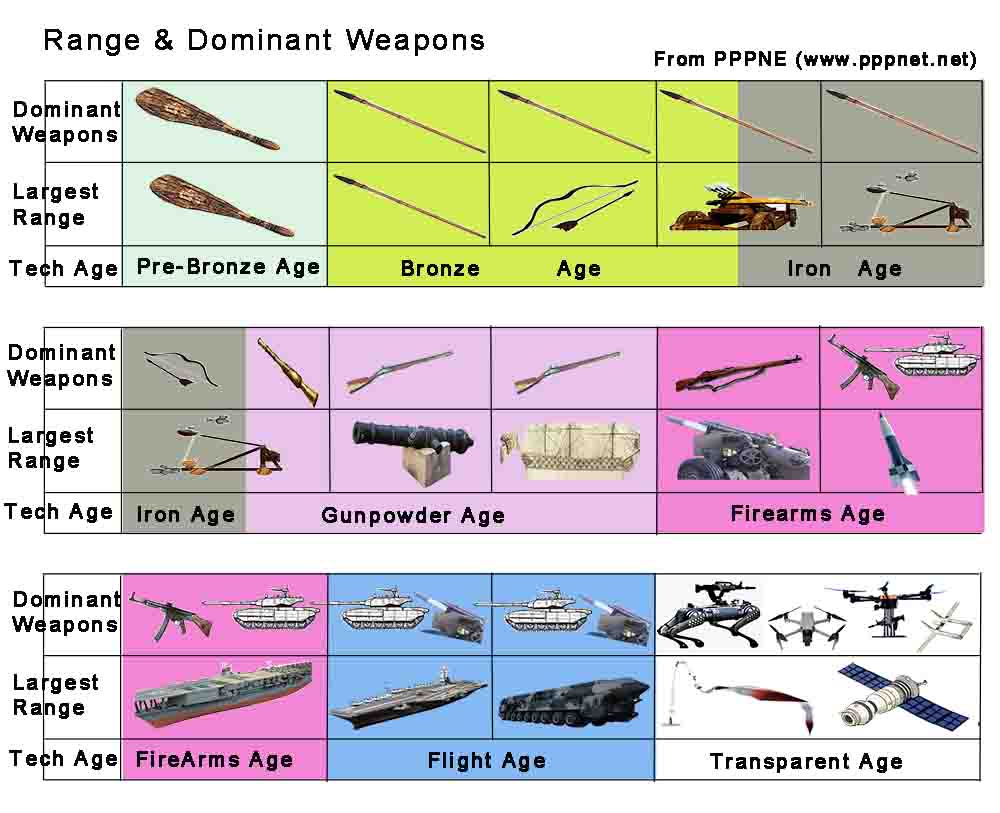
Abstract: The history of military progress is a history of pursuing better “effective weapon range.” Weapons are tools used to destroy the enemy. The ultimate destructive effect of a weapon can be perfectly reflected by its “effective weapon range.” The earliest recorded dominant battlefield weapon in China was the pestle (刂), an effective weapon for transmitting physical force. After the Bronze Age, the dominant battlefield weapon quickly evolved into the spear. It could achieve the same destructive effect at a slightly longer combat distance than the pestle, while the cost of upgrading weapons did not cause economic hardship for the country. The bow and arrow set was the first generation of long-range weapons in history. Its emergence transformed military theory. The form of military combat changed from large-scale clashes to the ability to kill the enemy without contact, relying on geographical factors. Even though the bow and arrow was a revolutionary advancement, it did not replace the spear as the dominant battlefield weapon for more than 1,000 years. The fundamental reason was the limitation of economic costs. The bow and arrow finally had a brief period of dominance during the Mongol Empire. After about 100 years of its appearance, the firearm quickly overshadowed the bow and arrow. When its effective range was shorter than that of a bow and arrow, it replaced the bow and arrow. When its use was limited by environmental constraints (it couldn’t be used in the rain), it replaced the bow and arrow’s historical position. The main reason was economic. Its manufacturing cost was not higher than that of a bow and arrow. Its training cost was far lower than that of a bow and arrow. Its maintenance cost was far lower than that of a bow and arrow. Its operating cost was also far lower than that of a bow and arrow. This allowed it to replace the bow and arrow as the dominant weapon on the battlefield even when its range was shorter than that of a bow and arrow. Later improved firearms followed this development path. Heavy machine guns were key weapons in both World War I and World War II, but ultimately failed to become the dominant weapon due to economic reasons. The revolutionary V1 and V2 rockets, as well as massive heavy artillery, failed to reverse the disadvantages of the German air force and navy, also for economic reasons. The Tiger tank, with its superior offensive and defensive capabilities, was ultimately defeated by the weaker T3, T4, and Sherman tanks, also for economic reasons. Even now, with many countries possessing missiles with ranges exceeding 10,000 kilometers, they are unlikely to become the dominant weapons on the battlefield today. This is also important evidence that economic factors determine the value of weapons. If it is ultimately proven that the “effective weapon range” of medium-range missiles exceeds that of aircraft carrier battle groups, the decline of aircraft carriers will be an inevitable path. The decline of the political power parasitic on aircraft carriers will also be an inevitable expectation. The “effective weapon range” consists of three factors: kill distance, destructive effect, and economy.
I. The history of war is essentially a history of progress in Weapon Effective Range.
1.1. Definition
Weapon Effective Range: The weapon effective range is mainly composed of three components: Range; Lethality; and Economy (capability for large-scale use).
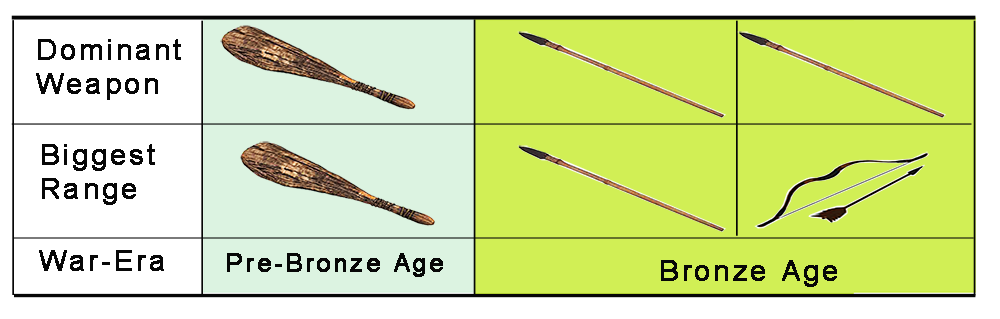
1.2. First-generation battlefield dominant weapons: wooden clubs and lance
A review of ancient Chinese warfare history reveals that before the application of bronze technology, the dominant weapon was the wooden club (or pestle). After bronze technology was introduced, the dominant weapon shifted to the spear. This upgrade was based on two factors: first, the spear’s longer range allowed for greater lethality than the wooden club; and second, a comprehensive upgrade from the wooden club to the spear would not lead to the collapse of the national economy.
1.3 Second-generation primary weapons: bows and crossbows:
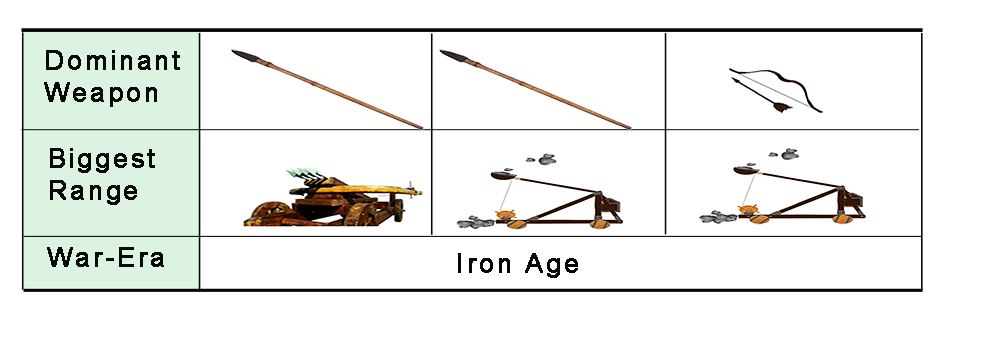
Figure 10: The first generation of long-range weapons in history – bows and arrows, crossbows, and catapults.
The bow and arrow was the first truly long-range weapon in history. It represented the first revolutionary advancement in weaponry. The advent of this weapon changed the nature of warfare. For the first time, it was possible to achieve victory by using terrain and enemy positions to block and kill the enemy without direct contact.
However, for over a thousand years of recorded history, the bow and arrow never replaced the spear as the primary weapon of war. The main reason was cost, which limited its scale of operation. High costs in production, storage and maintenance, and personnel training prevented the bow and arrow from becoming the dominant weapon of ancient Chinese armies for over a millennium, despite coexisting with the spear. It wasn’t until the Mongol Empire that the bow and arrow set first became the primary weapon in ancient warfare.
In the Battle of Crécy, the shorter-range, less lethal bow defeated the combination of the longer-range, more powerful crossbow and heavy cavalry. The logic is that economic efficiency determines the outcome of a war or battle. Economic efficiency is a crucial factor in the effective range of weapons.
1.4 Third-generation dominant weapons in Gunpowder Age
1.4.1 Handguns:
Even before its effective range was comparable to that of the bow and arrow, the musket quickly replaced the bow and arrow as the dominant weapon. This was because the manufacturing cost of the musket was not more expensive than that of a precision bow and arrow, while the training and operational costs were significantly higher. This demonstrates that effective range plays a far greater role on the battlefield than killing distance.
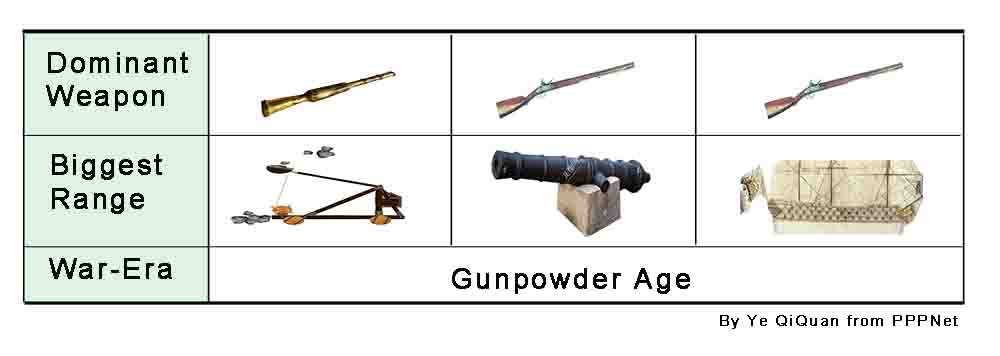
Figure 12: The musket replaced the bow and arrow in history when its killing range was inferior; the percussion gun once dominated a period of warfare.
1.4.2 Flintlocks / Muskets:
Later-developed percussion muskets had better range, faster firing rates, and higher efficiency. The pursuit of greater effective range involved simultaneously increasing firing distance and firing rate while also considering economic costs. Heavy machine guns possessed greater range and higher firing rates, but their economic cost meant they could only be key weapons during World War I, rather than decisive or dominant ones.
1.5 Fourth-generation dominant weapon in Firearms Age:
1.5.1 Napoleon’s Cannons
The relentless pursuit of greater range and more effective destructive power determined that artillery would inevitably appear on the battlefield. The Napoleonic era was a brief period where artillery was decisive. However, the economic characteristics of artillery limited its historical importance. It wasn’t until World War II that mobile artillery (tanks) finally became the dominant force in warfare on the European battlefield (the plains).
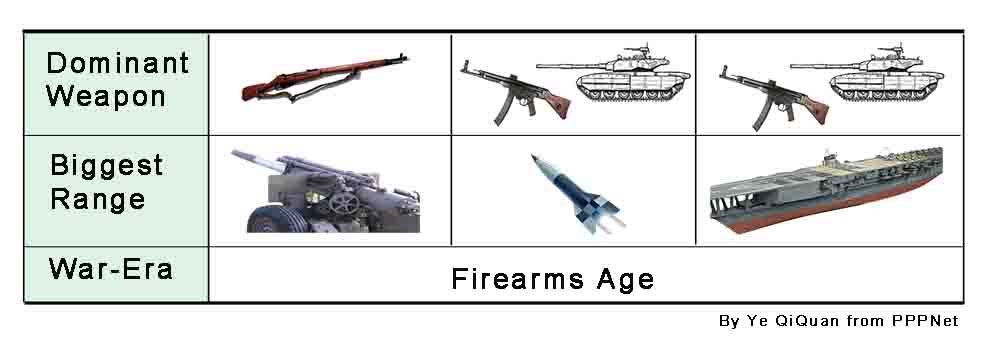
1.5.2 Naval Weapons:
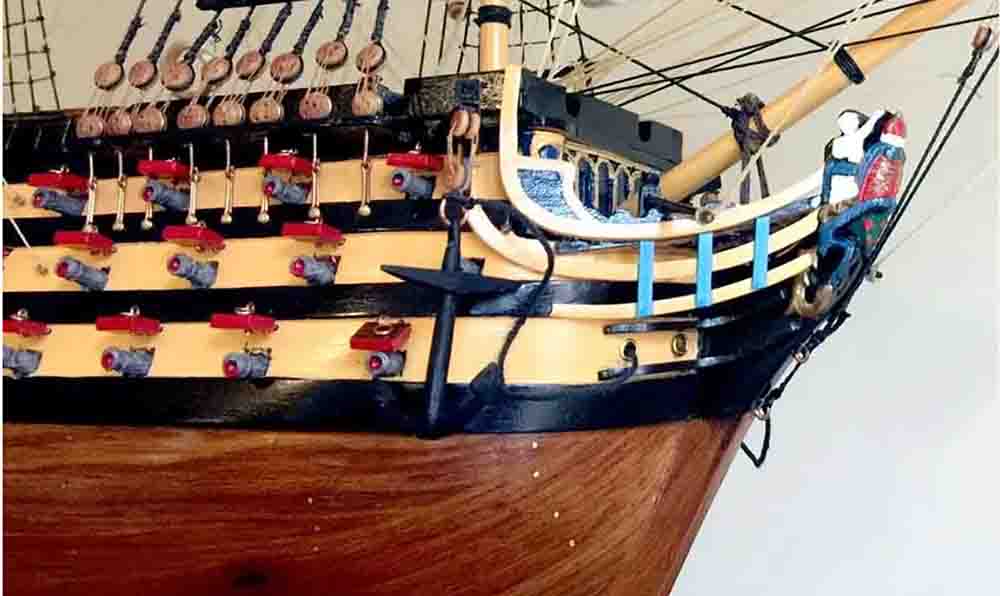
Figure 14: For the past 400 years, shipborne weapons have maintained the advantage of kill range and effective firing range.
Due to the high load-bearing capacity of warships, heavy and massive artillery can be mounted on them. This led to the development of naval guns with extremely powerful calibers and ranges. Furthermore, the mobility of warships, in terms of both time and space windows, substantially provided these guns with reusability.
This gave naval artillery a comprehensive advantage over land-based artillery in terms of effective range, lethality, and operating costs. Relying on its superior effective range, naval artillery could destroy land-based artillery, while land-based artillery could not destroy naval artillery. This ushered in the era of naval supremacy in military history. Naval supremacy protected the military and political advantages of the Spanish Empire, the British Empire, and the American Empire.
1.5.3 Mobile Artillery of World War II
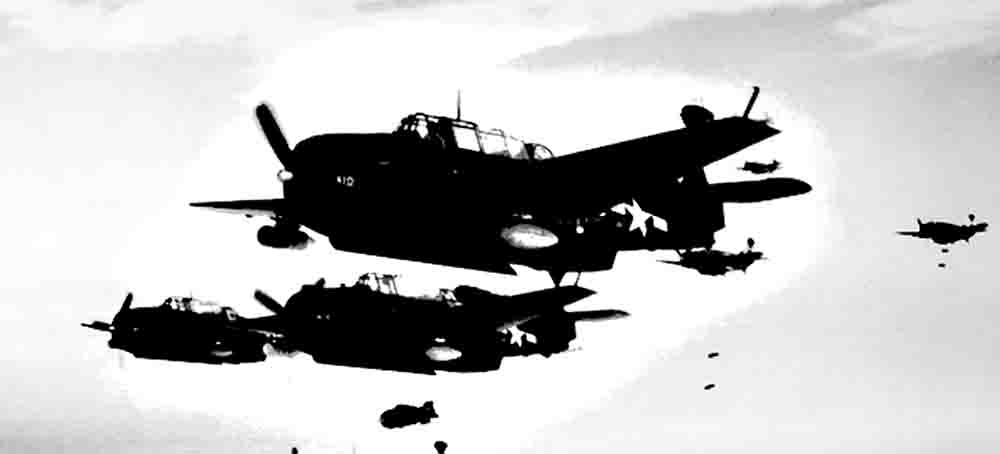
Figure 15: Composite range weapons determined the outcome of the Asian theater of World War II.
1.6 Fifth-generation dominant weapon in Composite range weapon Age / Flight Age
The Asian theater of World War II served as a prime example of the forefront of weapons technology advancements, vividly demonstrating the theory that “the effective range of weapons determines the final outcome of war.” With mobile airfields and carrier-based aircraft having ranges far exceeding the gun range of battleships, battleships and cruisers completely lost their anticipated combat effectiveness. There was even a case where one of the most advanced battleships (the Musashi) was sunk by aircraft launched from an aircraft carrier on its maiden voyage into battle.
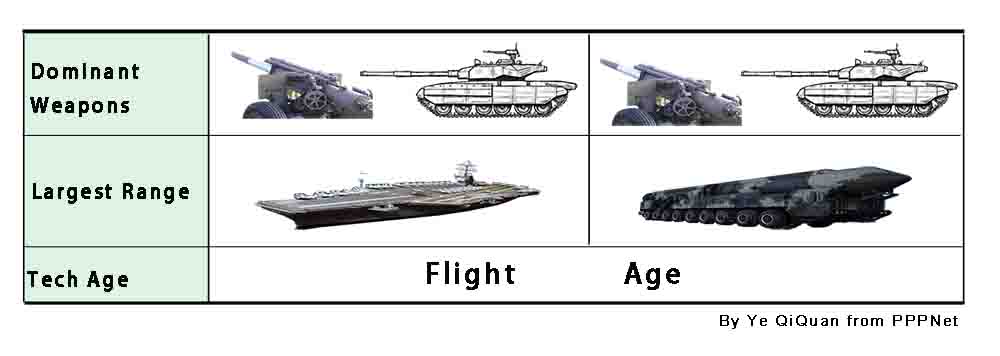
1.7 Sixth Generation Dominant Weapon in Long-Range Weapons Age / Transparent Age
With the V1 and V2 rockets as examples, a new generation of long-range weapons officially entered the battlefield. However, the revolutionary and state-of-the-art V1 and V2 could not reverse Nazi Germany’s air and battlefield disadvantages. The reason was that the V1 and V2 lacked the economic efficiency that a dominant weapon in warfare must possess.
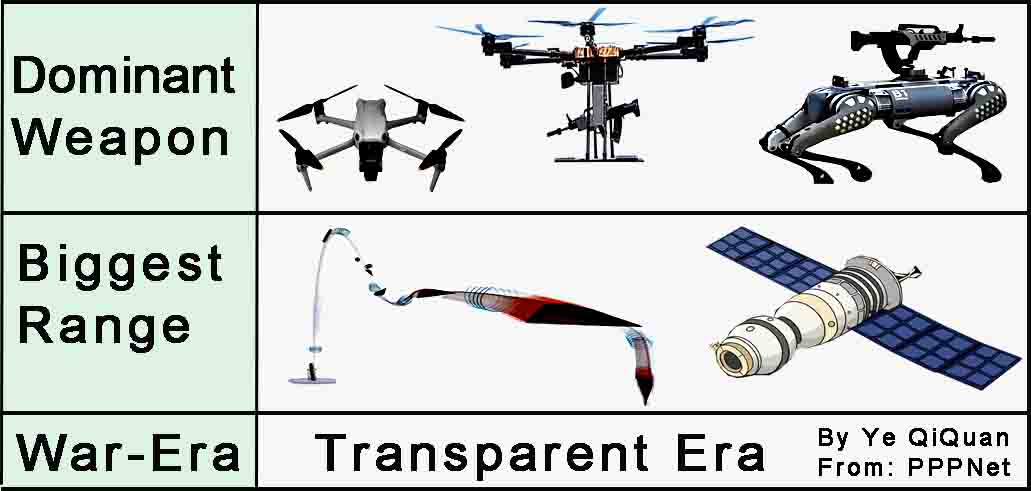
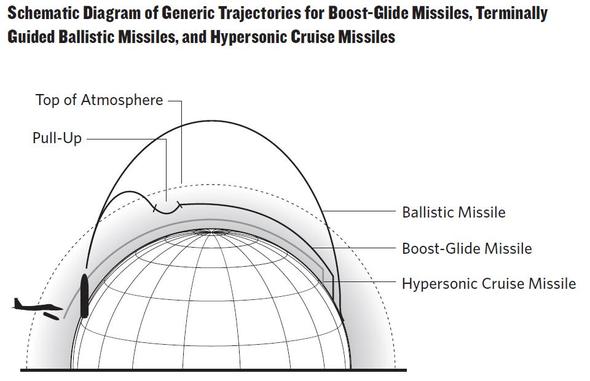
The longest range of missiles now exceeds 10,000 kilometers. However, long-range missiles are still not the dominant weapons in conventional warfare. For economic reasons, long-range missiles lack the power to dominate the course of conventional warfare. For example, Ukraine has chosen to abandon its existing long-range missiles because it cannot afford to maintain them. Even if North Korea possessed the capability to launch long-range missiles, it would be unable to utilize such weapons in actual conventional warfare.
There is even another extreme possibility: that owning and using excessively expensive weapons becomes the main reason for the user’s ultimate failure.
Economy, repeatability, and affordability are the most important factors in the dominant weapons of war. Their importance even surpasses that of kill range and destructive effect.
II. Economy is the most fundamental characteristic of dominant weapons.
2.1 Social organizational capacity promotes socio-economic development
2.2 Sustained warfare capability is the fundamental support for armed forces capability.
2.3 Economic power ultimately determines the outcome of a war.
III. The Significance of China’s Medium-Range Missile Group
3.1 Economies of scale bring cost effects
| Cost-Effective Ratio of Chinese Anti-Ship Missiles to US Carrier Battle Groups | |||
| project | Unit price (million US dollars) | Exchange value (millions of US dollars) | Equivalent quantity (pieces) |
| Dongfeng 21D | 24 | 26935.3 | 1122 |
| Dongfeng-26 | 30 | 26935.3 | 898 |
| Compiled by: Ye Qiquan (PPPNet www.pppnet.net) | |||
Table 2: Cost-Trade Ratio of Chinese Anti-Ship Missiles to US Carrier Battle Groups
3.2 The Window to Reopen the Era of Land Power:
Regarding China’s intermediate-range missiles, two important characteristics have been implicitly accepted by the online forces. They are range and economy. The online public opinion now implicitly accepts that the range of China’s intermediate-range missiles far exceeds that of the United States’ mobile airfield plus carrier-based aircraft plus carrier-based cruise missiles. In terms of economy, it is implicitly accepted that the manufacturing cost of 900-1100 intermediate-range missiles is equivalent to the cost of a US aircraft carrier fleet (one aircraft carrier plus 4-8 combat ships plus 50-60 carrier-based aircraft plus 1 submarine)[10].
| Table: U.S. Carrier Strike Group (Manufacturing Cost) (Millions of USD) (2021 Data) | |||
| Composition [3] | Quantity [3] | Original manufacturing cost per unit (million US dollars) | Original manufacturing cost |
| Aircraft carrier (CVN-78) | 1 | 12471.0 [5](2021) | 12471.0 |
| Cruiser (CG) | 1-2 | 1000 [4] (2021) | 2000 |
| Destroyer (DDG51) | 2-3 | 739.2 [6](2021) | 2217.6 |
| Frigate (FFG62) | 2-3 | 943.73 [7](2021) | 2831.2 |
| Submarine (SSN774) | 1 | 1807.4 [8] (2021) | 1807.4 |
| Support ship (TAO 205) | 1 | 591.6 [9] (2021) | 591.6 |
| F-35 air superiority fighter | 20-28* | 94.4 [4] (2021) | 2360 |
| F/A-18 strike fighter | 30-36 | 29 [4] (2021) | 1044 |
| Early warning aircraft (E-2C/D) | 4 | 80 [4] (2021) | 320 |
| Electronic warfare aircraft (ES, EA, E-2D) | 14 | 80 [4] (2021) | 1120 |
| Rotorcraft (UH-60M) | 6 | 15.8 [10] (2021) | 94.6 |
| Transport aircraft (C-2A) | 2 | 38.96 [4] (2021) | 77.92 |
| Total manufacturing cost | 26,935.3 | ||
| Compiled by: Ye Qiquan (PPPNet www.pppnet.net) | |||
Table 4: Cost of Manufacturing a US Aircraft Carrier Strike Group
If the third characteristic, destructive effect, is verified to be true in a small-scale probing battle, then China’s medium-range missiles may comprehensively surpass US weapon systems in all three aspects constituting their effective range.
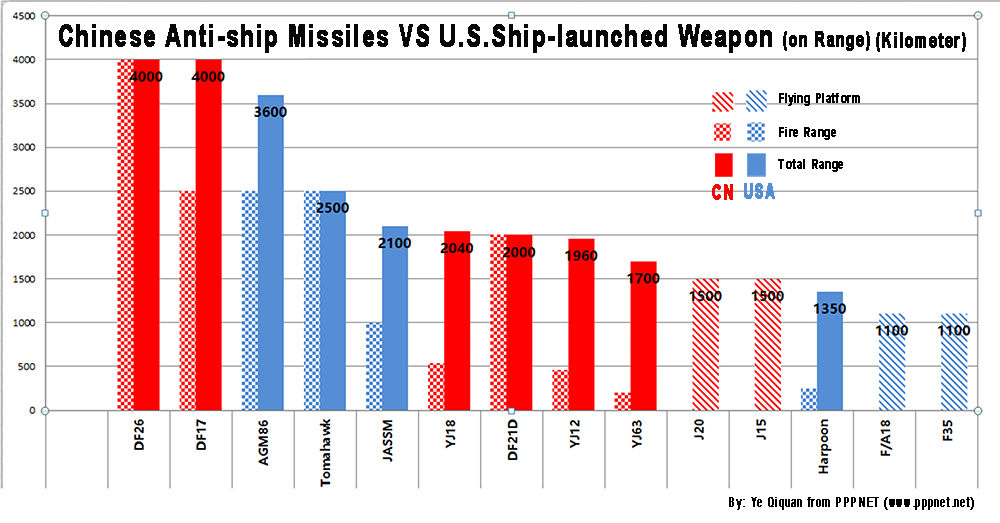
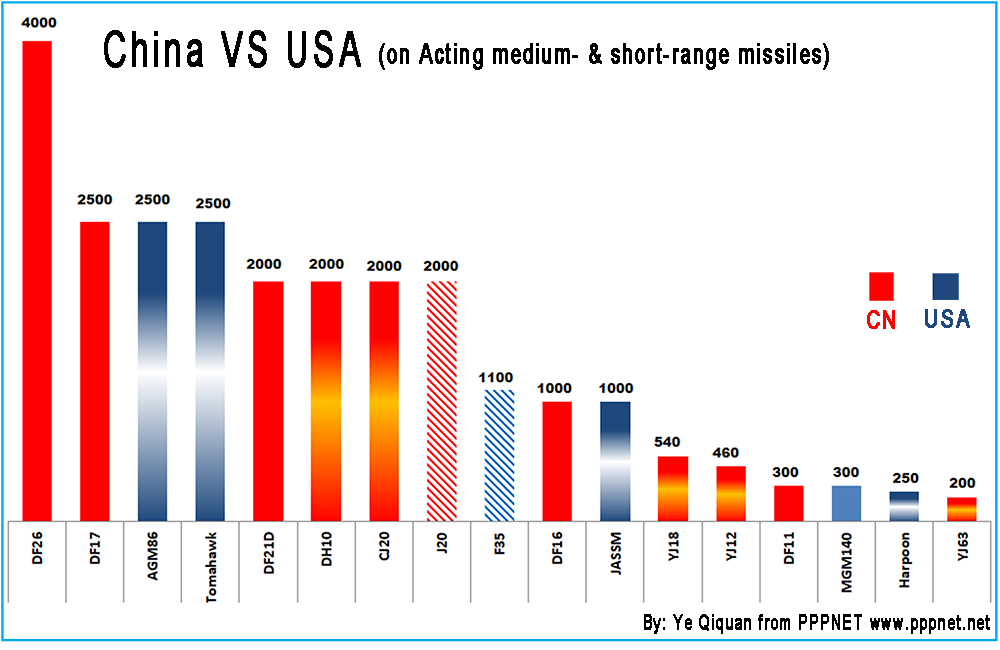
If this possibility is ultimately confirmed, it will not only lead to the decline of American power, but will also usher in an era in which land-based warfare power suppresses naval warfare power.
If this possibility is ultimately confirmed, the United States will automatically shrink its sphere of influence. China will not necessarily have to force the United States to retreat through a full-scale war. This is a huge temptation for China. Therefore, launching a small-scale exploratory or demonstrative war is an irresistible temptation for China.
3.3 Political power depends on overall military capability