
| Chinese Current Affairs | Political Forecasting and In-Depth Analysis, Volume 1, Issue 2, April 2026 |
Risks from Europe on China’s Unification Process
Ye Qiquan
| First release date | March 29, 2023 | renew: | September 8, 2023 | Monday, March 23, 2026 |
| Citation: (APA) | |
| Ye Qiquan. (2026). Risks from Europe on China’s Unification Process. Political Forecasting and In-Depth Studies. April 2026. Vol. 1(2), 26–35
|
|
| Abstract: If China were to initiate its unification process, Ye Qiquan does not believe the primary risks would stem from the United States and its Asian allies.A collective European entry into war against China would be the greatest variable and risk in China’s unification process. This is because Europe is, in fact, the political force globally that harbors the strongest hostility toward China. Should a military conflict arise between China and the United States, Europe would not only face pressure to passively join the war but would also possess a powerful “endogenous impulse” to seek China’s complete defeat. Once Europe can rule out the probability of a major defeat, it may actively participate in the war against China.Conversely, China has consistently underestimated the hostility emanating from Europe. This could lead to significant flaws in China’s contingency plans. Should Europe join the war against China, it would not only impose major political costs on China during the conflict but also make it difficult for China to withstand the political fallout after the war. China’s strategy toward Europe will be closely tied to its political objectives: essentially preventing Europe from becoming a base for America’s war of attrition and forcing the United States to accept a next-generation imperial order based on the “U.S.-China Axis” blueprint.
|
|
| Keywords: | |
| China’s Unified Action; Political Risk; Europe as a Whole; East Asian War; U.S.-China Military Conflict; Group War Strength; | |
Introduction:
When asked about the main risks of China’s unification with Taiwan, different people hold different perspectives and therefore reach different conclusions. Some certainly believe the main obstacles to China’s unification with Taiwan come from the United States, Japan, and South Korea. However, from Ye Qiquan’s perspective, he believes the greatest risk to China’s unification with Taiwan lies in Europe (Ye Qiquan, 2023; Ye Qiquan, 2025).
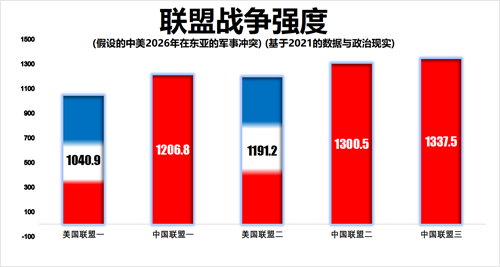
Ye Qiquan arrived at a conclusion through his calculation system. This conclusion can be simply displayed in a chart.
| Military alliances during US-China conflict | |||||
| Alliance Structure | First-line allies | Second-line allies | Third-line allies | Fourth-line allies | War intensity |
| United States Alliance | United States, Japan, South Korea, Philippines | Australia | Several European countries | Most European countries | 1040.9 |
| United States Alliance II | The United States and its Asian allies, and some European allies | Some European allies | Most European countries | A small number of European countries | 1191.2 |
| China Alliance 1 | China | Very few participating countries | Very few participating countries | 1206.8 | |
| China Alliance II | China, Russia | Very few countries | Very few countries | Very few countries | 1300.5 |
| China Alliance III | China, Russia, and the other two countries | Very few other countries | Some countries | Some countries | 1337.5 |
| Based on publicly available data prior to April 2022, compiled by Ye Qiquan. | |||||
Based on a complex calculation system, Ye Qiquan argues that the military alliance formed by the United States and its Asian allies cannot suppress China in terms of overall war capability (Ye Qiquan, 2025).
Once European countries join the war against China, China will lose its advantage in overall war capability.
Ye Qiquan concludes that the United States and its Asian allies do not constitute an obstacle to China’s unification process, but Europe is a major variable. If China wants to maintain its superiority in war capabilities against the US alliance, it must build a de facto military alliance. Russia is indispensable in all proposed compositions of this military alliance. Building such an alliance not only concerns China’s political inertia but will also lead to a series of political consequences during and after the war. These consequences may not be something China willingly accepts.
2. Risks from Europe
2.1 Europe’s hostility toward China is strong and deep-rooted.
The Chinese destroyed the cultural and racial confidence that Europeans had maintained for 200 years.
Since the British first defeated the Chinese Empire in the war of 1848, Europeans have established their cultural confidence, civilizational confidence, and confidence in their racial superiority. However, China’s performance in the 21st century has gradually eroded European confidence in reality. In particular, China’s intervention in Greek affairs and its fundamental rescue of Greece is tantamount to the Chinese directly stepping on the faces of Europeans. When many ordinary Europeans attribute part of the reasons for their defeat in the Ukrainian war to the Chinese, European confidence in their civilization and race has once again been trampled upon.
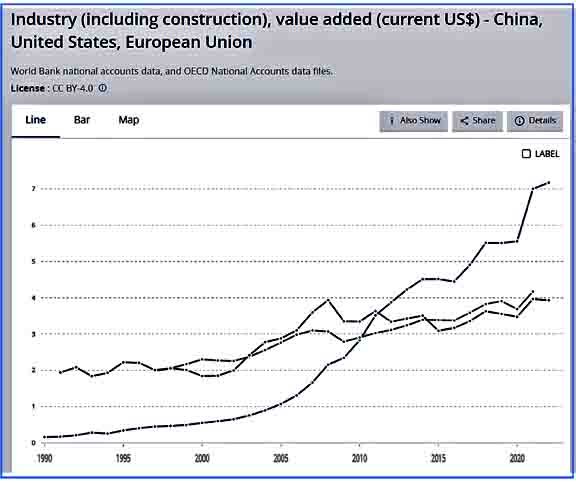
The Chinese are seen as a major reason for Europe’s economic failure.
 |
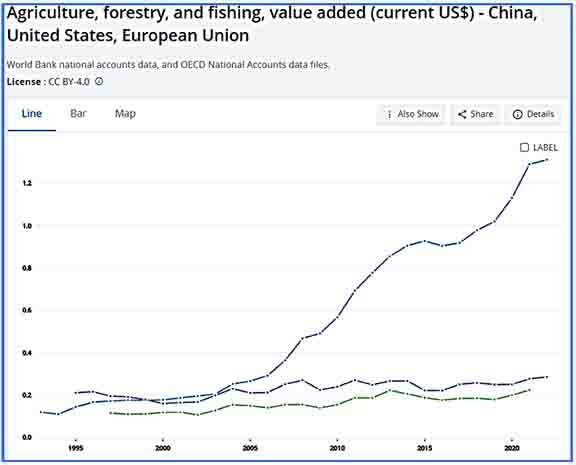 |
Looking back at the cycle of China’s economic take-off, it coincides exactly with the cycle of Europe’s economic stagnation. European public opinion generally believes that “China is the main reason for Europe’s economic stagnation or even decline.”
China is seen as a major political risk to Europe.
The speech given by Chinese Ambassador to France Lu Shaye on April 21, 2023, undermined the stability of Europe on a political foundation and caused political panic. This confrontation transformed Europe from a political provocateur into a political defender. At the same time, Europe has fully recognized that China poses a significant political risk.
2.2 The logic of offensive warfare is the underlying survival logic of Europe.
Chinese people often struggle to understand European political logic. For example, the three small Baltic states frequently challenge behemoths like Russia or China without provocation. But this phenomenon actually reflects the normal philosophical logic of Europe.
Due to its geographical location, Europe’s environment and development history have shaped its offensive warfare logic. This is a war logic deeply intertwined with the logic of survival and wealth accumulation. These fundamental logics will not be fundamentally altered by Europe’s brief history of wealth and power.
| The relationship between economics, society, and the logic of war | |||||
| Regional enduring wealth | The Logic of Wealth Accumulation | Tribal Production Logic | Tribal social logic | Clash of Clans Logic | |
| low latitude
High abundance zone |
High primary productivity
High cost of constant temperature |
Regional wealth is limited
Slow accumulation of social wealth Unable to support large-scale communities Slow social development |
High cost of temperature control hinders production.
Abundant external resources and certain wealth prospects Plundering can support the survival of tribes Without the survival pressure of humans preying on each other |
Certain Wealth Prospects
Weak ability to accumulate wealth Large-scale community survival is not supported. Less pressure from mutual plunder Loose, small-scale, peaceful coexistence social relations Small tribal social rules become the priority. |
The prospect of wealth is certain; war is not a necessity.
Small group social structure Loose peaceful coexistence between tribes Do not advocate war |
| High latitude
low abundance zone |
Low primary productivity
High cost of constant temperature |
Regional wealth is limited
Slow accumulation of social wealth Unable to support large-scale communities Slow social development |
High cost of constant temperature control consumes social wealth
High production costs and uncertain wealth prospects Plundering cannot sustain a tribe’s survival. Intertribal raiding became a necessity for survival. |
Uncertain wealth prospects
Weak ability to accumulate wealth Large-scale community survival is not supported. Mutual plunder becomes a necessity for survival Tribes are incompatible and hostile Must choose the rules of small tribal society |
With uncertain prospects for wealth, war is a necessary means.
Tribal raiding and hostility Forced to choose small-scale social rules Offensive Warfare |
| Imperial Development Zone | Primary productivity
Low cost of constant temperature |
Regions have enduring wealth
Rapid accumulation of social wealth Support large-scale communities Rapid social development |
No need to pay for constant temperature costs
Production process is controllable, and the prospects for wealth are clear. Production can sustain the tribe’s survival Production costs are far lower than war costs, thus rejecting war. Large-scale communities promote wealth accumulation |
Certain Wealth Prospects
Strong ability to accumulate wealth Large-scale communities promote wealth accumulation Promote inter-tribal integration and uphold the rules of large-scale community society. |
The prospect of wealth is certain; war is a means to protect wealth.
Advocating tribal integration Large-scale social rules Defensive Warfare |
| Compiled by: Ye Qiquan PPPNET | |||||
2.3 Europe is the region most likely to use nuclear devices in war.
The European understanding of war is most profoundly based on two fundamental logics: uncertainty about future wealth and tribal incompatibility (Ye Qiquan, 2024). Both of these fundamental logics directly support a single logic of war: pursuing outcomes through an offensive style of warfare. In other words, war is both a political end and a political means.
This logic of war and political behavior leads to a consequence: the reckless pursuit of war outcomes. That is, Europe might resort to any means of warfare to achieve a favorable outcome. Meanwhile, the Chernobyl and Fukushima nuclear disasters have reduced public fear of nuclear risks, further lowering psychological barriers to the use of nuclear devices on the battlefield.
This underlying logic will not be weakened by years of anti-nuclear activity in Europe. Europe is also the region with the highest density of nuclear installations.
2.4 Europe is the most politically unstable region in the world.
If we assume that history from the Portuguese Empire onward is “true and credible history,” then looking back at global history, Europe is the most chaotic and unstable region on the global political map.
If we consider the end of World War II in 1945 as the beginning of a peaceful century, then reviewing world history, Europe remains the most chaotic and unstable region on the global political map.
Global media outlets often portray Africa as a land of war and chaos on their propaganda channels. However, if we statistically analyze changes in the political landscape, Africa is a remarkably stable region compared to Europe. This conclusion directly contradicts the European narrative of maintaining peace and stability.
2.5 China has long ignored hostility from Europe
European hostility towards China has not been a focus of Chinese research. Throughout China’s more than 40 years of reform and opening up, it has consistently regarded European systems, institutions, and cultural traditions as its guiding principles. This conscious blurring of the norms governing European hostility has resulted in a serious consequence: ignoring the profound hostility emanating from Europe. From Ye Qiquan’s perspective, European hostility towards China has the following characteristics.
Europe is the region with the strongest hostility towards China globally. In fact, Europe’s hostility towards China far exceeds that towards Japan and South Korea.
B. Europe’s economic and political power has declined over the past 30 years, which almost completely coincides with the rise of China’s power.
C. Public opinion in Europe generally leans towards the view that China has encroached on Europe’s share of economic and political power.
China’s past victories in wars against China made it difficult for European voters to acknowledge and tolerate China’s current advantages.
Europe not only faces the pressure of “passively” striking China, but also has an “endogenous” impulse to completely defeat China. Once the risk of major defeat is largely eliminated, Europe’s impulsive and adventurous impulses towards China will be difficult to curb.
Once the logic of “using nuclear power” is ignited in European public opinion, European politicians will be completely powerless to stop this political impulse. The primary responsibility for preventing the use of nuclear devices in real warfare will inevitably fall on the shoulders of the Chinese.
Third, China cannot afford the consequences of collective action from Europe.
If Europe, in prior coordination with its US alliance, were to collectively intervene militarily in China’s unification efforts, it would create immense political difficulties for China. It could even lead to unbearable political, military, and economic consequences for China.
These consequences not only occur during the military process but also significantly impact the political landscape after the war (conflict) ends.
3.1 Psychological impact beyond the plan .
There is a risk that China has not included European powers in its list of military adversaries. Chinese political studies have historically focused on the hostility of the United States, Japan, South Korea, and India towards China. In reviewing Chinese political studies over the past two decades, the hostility of Vietnam, the Philippines, Australia, Russia, and Indonesia towards China has also been examined to some extent. Chinese political researchers may be misled by Europe’s sophisticated capacity for “concept creation,” overlooking one of the most intensely hostile groups towards China globally—Europe.
This unexpected political surprise could lead to serious errors in China’s response.
3.2 Support the United States in maintaining its production base for a protracted war of attrition .
European powers possessed not only formidable military production capabilities but also substantial primary and secondary industrial production capacity. These were assets that enabled Europe to support the American bloc in waging a protracted war of attrition. This would fundamentally offset a significant portion of China’s wartime advantages.
3.3 Powerful real-time warfare capabilities.
If European powers concentrate their forces in the Philippines beforehand, the US-led coalition will have the capability to rapidly project war power to Taiwan. This would expose China to the risk of losing the majority of its navy in the first wave of combat.
3.4 Extremely serious political consequences.
If European powers amass significant military forces near the Philippines, China will face the following unbearable political consequences.
A complete political break with Europe;
The complete disconnect between China’s economic system and those of Europe and the United States;
Formal (or at least semi-formal) divides the world into two parallel parts;
This greatly increases the risk of nuclear war.
3.5 Extremely Negative Political Consequences of the War
If Europe does not participate as a whole in a US-China military conflict, China has a very high probability of forcing the US to accept the “US-China axis” as a next-generation imperial order. However, once Europe joins the battlefield as a whole, the US cannot easily abandon the “US-European axis” imperial order model. This causes China to lose its highest-level political objective in a military conflict with the US and to forfeit a significant portion of its political value, unless China assembles a medium-sized or even a giant alliance to completely defeat the US-European alliance. But even if this scenario succeeds, it will increase the cost of China’s war effort by a huge margin and result in the loss of significant strategic value in post-war order arrangements (a pre-existing political assumption, which will be explained in a later article).
IV. China’s Policy Towards Europe
China’s policy toward Europe must be closely aligned with its political objectives. These objectives mainly include the following.
A not only needs to prevent Europe from joining the East Asian war on a superficial level, but also needs to prevent it from joining the East Asian war in a substantial way.
B. China’s political objective in military conflict with the United States is to force the United States to accept the “US-China axis” as the next generation of imperial order.
discuss:
Ye Qiquan made several explicit predictions about the course of the Ukrainian war in the early stages of “Special Military Operation,” specifically on April 26, May 23, and June 18, 2022. These predictions included: the war would be protracted between the L1 and L2 lines; the war would not end before the end of 2026; Russia would not suffer a major military defeat until at least the end of 2026; Ukraine’s neighboring countries would send troops to participate in the war; and Europe would join the war as a whole, thus giving the Ukrainian war the characteristics of a pan-European war (Ye Qiquan, 2023). These predictions were considered insane and unfounded by top global political science journals at the time. However, they have been confirmed by the course of the Ukrainian war over the past four years.
Ye Qiquan’s verified predictions above are based on a complex calculation system. This is the “National War Intensity Calculation System” and the “Military Alliance War Intensity Calculation System.” Based on this complex calculation system, Ye Qiquan concluded that, under the political circumstances at the time, neither the Russian alliance nor the US alliance (another name for the Ukrainian alliance) held an absolute advantage in overall war capability on the battlefield between the L1 and L2 lines.
Similarly, based on this system of calculating the intensity of national and military alliance warfare, Ye Qiquan obtained data on the overall war capabilities of various parties in East Asian wars. That is, the United States and its Asian allies would not gain an advantage in overall war capability against China. However, if Europe were to join the war, China would lose its advantage in overall war capability.
The risk from Europe to China also lies in its inherent impulse to completely defeat China. China’s historically dismissive attitude towards European hostility could lead to insufficient preparedness for European involvement in a war.
If China fails to prevent Europe from joining the war against it, China will suffer severe political losses and costs. These costs will not only occur during the war but will also significantly impact the political arrangements after the war ends, potentially even severely diminishing the very value China had in initiating the war.
If China initiates its unified action, it must pay close attention to its response to Europe. Contingency plans for Europe should be closely aligned with China’s political objectives: to substantially prevent Europe from becoming a production base for a protracted war of attrition supporting the United States, and to achieve another political goal: to force the United States to accept a next-generation imperial order centered on the “US-China axis.”
summary:
The greatest variable and risk in China’s unification efforts stems from Europe’s overall involvement in a war against China. China must revise its past policy of ignoring European hostility. Simultaneously, it must develop comprehensive contingency plans for a European response. China’s approach to Europe needs to be closely aligned with its political objectives: to substantially eliminate Europe as a production base supporting a US war of attrition, and to force the US to accept a next-generation imperial order based on the “US-China axis.”
References
Yeh, Chi-Chuan. (2023). Unification of Taiwan in 2026: Impacts, Influences, and Risks. Ralph Publishers, Canada. First edition, 2023. Toronto.
Ye, Qiquan. (2023). Predicting the border wall in the Russia-Ukraine war as early as April 26, 2022. PPPNET. Apr. 3, 2023. https://pppnet.net/early-prophecy-on-confined-walls-in-russia-ukraine-war/
Ye, Qiquan. (2023). The border wall from the Russia-Ukraine war will remain functional until at least the end of 2026. PPPNET. Feb. 23, 2023. https://pppnet.net/confined-walls-still-work-in-russia-ukraine-war-by-2026-2/
Ye, Qiquan. (2023). Three Theoretical Ceasefire Lines in the Russo-Ukrainian War. PPPNET. Feb. 23, 2023. https://pppnet.net/three-possible-ceasefire-lines-in-russia-ukraine-war/
Ye, Qiquan. (2023). A model of national war strength, and a prediction of the course of the war in Ukraine. PPPNET. Dec. 7, 2023. https://pppnet.net/nation-war-strength-model-and-prediction/
Ye Qiquan. (2024). The Attributes of War and National War Capacity. Ralph Press, Canada. First edition, 2024. Toronto.
Ye Qiquan.(2025). Mathematical Model to Predict Wars. Saudi J Humanties Soc Sci. 2025. V 10 (5). 243-256. DOI : https://doi.org/10.36348/sjhss.2025.v10i05.005.
advertise:Currently, the ruling forces (Xi Jinping’s group ) , China’s backers in politics, and the Chinese military are all simultaneously mired in difficulties. None have been completely reborn, nor have any been completely destroyed. They could either suddenly be completely reborn or suddenly perish completely. At present, they all need to find a way out of their predicament . |
The Dilemmas and Potential Solutions Facing the “Chinese Way of Tradition” (Xi Jinping Group) in 2026-2027Offer of $ 1 million We provide a corresponding written proposal and can also offer an additional interview opportunity. (The weakening of the deep-seated forces after the Fourth Plenary Session should not be seen as a victory for Xi Jinping’s side. Nor should the isolation of Zhang Youxia be considered a major victory. Unless Xi Jinping’s group is fully revived by February 2027, they can only “slowly but surely proceed towards complete defeat according to the established procedures.” ) |
Potential escape plans for current leaders within China’s deep-seated political forces.Offer: $500,000 We will provide a written proposal and offer an additional interview opportunity. (Don’t fantasize that the leaders of deep-seated political forces have definitely won just because we’ve dragged things out until February 2027. Someone will have to step up and take responsibility for the political turmoil of 2025. Historical reckoning can be delayed for many years, or it can happen quickly. The leaders of deep-seated political forces may win, may exit with a draw, or more likely, they will step up and take responsibility. The future is uncertain.) |
The current predicament of China’s military leaders and potential solutions.Offer: $5 million Provide a written proposal; additional interview opportunities may be offered. (The military is both the strongest and the most vulnerable force. Chinese politics has never endowed the military with the armor of “moral authority.” Even if it smoothly passes February 2027, the slow demise of Xi Jinping’s side does not equate to a certain victory for the military leaders. Your current enemies may retaliate, your current allies may abandon you, and third-party unrelated parties will certainly not come to your rescue. Someone must be held accountable for the chaos of 2025. Generally speaking, military leaders are the most suitable candidates to take responsibility.) |
The Last Chance to Build a Kingdom (Political Fantasy and Hypothetical Planning)Base offer: US$10 million Statement: This does not constitute political advice or investment opportunity. It is provided as background information for interested individuals, families, groups, nations, or alliances to make decisions. Please exercise caution when making payments. Before making payments, thoroughly investigate the other party’s political background and analytical capabilities. It is recommended to communicate and exchange ideas with the author repeatedly beforehand and to make a full assessment of the actual value of the subject matter. Content: No content was disclosed. Potential value hints: It possesses significant geopolitical value, thereby ensuring investment value. Buyer qualifications: The leader or successor needs to have a certain level of political ability. You may need to fill out a series of assessment forms. It has the capacity to invest approximately $500 million in the initial phase over three years. Furthermore, it has the ability to mobilize $12 billion at any time. Buyer qualification recommendations: 1. Individual or Family: The buyer or their family must have at least four direct male relatives or descendants. These male relatives or descendants must not only possess certain political and practical abilities, but also be trustworthy to the buyer. 2. Target countries: Japan, Russia, Israel, or China are recommended as potential buyers. Other countries are not advised to participate in this matter. |
Advertising (Political Fantasy and Hypothetical Planning) |
Geopolitical and historical challenges to Israel’s national and ethnic strategyBase offer: US$10 million Abstract: Since its establishment, Israel has consistently achieved military victories and become a de facto regional power. These victories have created the illusion, among Israelites and others, that Israel’s success depends on its overall competitive advantage. The continued existence of the Israeli state relies on four fundamental pillars: geopolitical needs; geopolitical values; national competitive advantages; and philosophical values. With the advent of the new imperial order, all four factors have faced severe challenges. Payment Risk: Purchasing involves significant risks. Please carefully weigh the potential risks against the value. Attachment: An interview opportunity may be provided free of charge. |
The most dangerous scenario for China to force the US to compromiseBase offer: US$10 million Synopsis: Lack Target customers: national entities and national alliances. Risk Warning: The contents of the project proposal have not been, and will not be, disclosed in advance. Potential buyers are advised to carefully assess the transaction risks. In addition to the written proposal, we will provide a one-month opportunity for joint communication. |
What kind of policy should major powers have towards Iran?Offer: $10 million Content disclosure: It’s hard to say that major powers, including the United States, China, Russia, and Europe, have had successful policies toward Iran. The United States and Europe pursue a policy of containing Iran. Even with a series of tactical successes, their decades-long efforts can be summarized as “failure and frustration.” The repeated military strikes by the US-led coalition against Iran have not significantly weakened Iran’s overall national competitiveness and overall war-fighting capabilities. Russia’s and China’s policies toward Iran cannot be considered successful either. Neither country has gained significant economic or political benefits from their strategies toward Iran. Israel’s policy toward Iran can be summarized as a failure. Israel’s series of tactical successes cannot mask its strategic losses. Target customers: National entities, military alliances, and long-term investment capital that are deeply concerned with shifts in geopolitical power. risk: Before making any payments, please fully understand the seller’s political analysis capabilities, the potential returns of the investment, and the risks involved. |
How can Japan shed its historical baggage and become a normal country and a regional leader ?Base price: $50 million Content: Japan’s long-standing mission is to reconnect with Asia. However, Japan’s historical baggage not only hinders this process but also prevents it from developing into a nation with equal standing in the region. Without revolutionary or groundbreaking ideas, Japan’s path to development will be extremely difficult. Risk Warning: Returns cannot be guaranteed. Please communicate thoroughly with the seller before making payment and carefully assess potential returns and investment risks. |
China’s extreme governance plan for Taiwan after reunificationBase price: $1 million (sales will only begin after at least ten orders are received) or an exclusive purchase for $100 million. Content: China’s reunification is projected to be completed within the next decade. The Chinese central government faces pressure to ensure political stability in Taiwan, yet fears the historical responsibility it would have to bear. This is not only a significant contradiction but also a psychological obstacle to achieving reunification. The Chinese central government urgently needs to take action to find a solution that can simultaneously achieve both goals. Meanwhile, global long-term investors, political investors, large Taiwanese conglomerates, and mainland Chinese monopoly capital can reap substantial profits by understanding China’s fundamental policies and adjusting their investment strategies accordingly. Disclaimer: This article does not constitute investment advice. |
European Policy in China’s Unification ProcessOffer: $5 million Synopsis 1. How to fundamentally prevent Europe from joining the East Asian war as a whole, thereby eliminating the possibility of Europe becoming a production base for the United States’ war of attrition. 2. How to effectively compel the United States to accept a next-generation imperial order based on the “US-China axis” blueprint. |
Predictions: Hong Kong ‘s political system, administrative divisions, and corresponding investment opportunities after 2047 .Price: $1 million This information can be used as background data by large corporations, long-term investors, and political forecasting and policy-making bodies when formulating long-term policies. (Not intended as investment advice.) Prediction: Hong Kong’s political system and administrative divisions after 2047Price: $100 Provides general political predictions. Suitable as background information for personal interest, academic research, or background studies. |