
Long-Term Forecasting: Political Forecasting and In-Depth Analysis, Volume 1, Issue 1, February 2026
Prediction: Hong Kong’s political structure after 2047
Ye Qiquan
| First release date: | Friday, February 13, 2026 |
| Reference data: (APA) |
| Ye Qiquan. (2026). Hong Kong Prediction: Political Structure After 2047. Political Prediction and In-Depth Analysis. 2026. Vol. 1(1), 8-9. |
| Abstract: Since 2012, Ye Qiquan has argued that Hong Kong faces the risk of shrinking “two systems” space. Ye believes that after 2047, the probability of Hong Kong maintaining “two systems” space or “substantive autonomy” is close to zero. The current Hong Kong Special Administrative Region will be divided into three provincial-level administrative units and one sub-provincial-level administrative unit. This basic structure will provide the Chinese central government with sufficient space to govern Hong Kong. The interaction between the central government and Hong Kong locals at that time will also affect the specific setup and configuration of the sub-provincial-level administrative region, the “New Territories Southern District.” The article provides different prediction details for personal and corporate versions. |
Keywords: prediction; Hong Kong; 2047; one country, two systems; administrative division; provincial-level administrative region; sub-provincial-level administrative region
In 2014, I briefly predicted that Hong Kong might lose its “two systems space” or “substantive autonomy” after 2047. This article summarizes my previous scattered thoughts. The main theme can be titled “Hong Kong’s Political Model After 2047,” or “Hong Kong’s Two Systems Space After 2047.” The key points are as follows:
- Hong Kong may retain the name, title, or political definition of “two systems,” but “the political space for Hong Kong to continue to retain substantive two systems, or substantive autonomy, after 2047 is close to zero.”
- Hong Kong’s overall political space has shrunk, and its economy has also contracted.
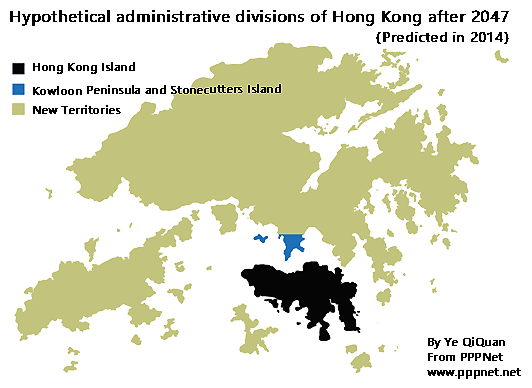
- It is highly likely that Hong Kong will have three provincial-level administrative units: “Hong Kong Island,” “Kowloon,” and “New Territories.” The names may differ, but the administrative divisions will largely follow the scheme shown in the attached map.
- Another major feature of the new Hong Kong administrative divisions is the creation of a “sub-provincial New Territories Southern District” within the “New Territories Provincial Administrative Region” (the name may differ; its administrative rank is lower than that of a provincial administrative region, roughly equivalent to a current “sub-provincial administrative region,” or a “city with independent planning status,” or a “special autonomous prefecture” in China). (At the same time, the actual geographical area, political rank, and economic and financial level of this “New Territories Southern District” were closely related to the degree of interaction between the central government and the people of Hong Kong at that time.) In other words, the future of the “New Territories Southern District” depended on:
A. The degree of obedience of Hong Kong people to the central government; B. The degree of liking or disliking of Hong Kong people by the central government; C. The degree of toughness of the central government at the time.
- The coexistence of multiple administrative districts provides the central government with ample political maneuvering space to win over the hearts and minds of Hong Kong people.
The central government’s overall attitude toward Hong Kong was also closely related to China’s position in the world order at that time.
advertise:Currently, the ruling forces (Xi Jinping’s group ) , China’s backers in politics, and the Chinese military are all simultaneously mired in difficulties. None have been completely reborn, nor have any been completely destroyed. They could either suddenly be completely reborn or suddenly perish completely. At present, they all need to find a way out of their predicament . |
The Dilemmas and Potential Solutions Facing the “Chinese Way of Tradition” (Xi Jinping Group) in 2026-2027Offer of $ 1 million We provide a corresponding written proposal and can also offer an additional interview opportunity. (The weakening of the deep-seated forces after the Fourth Plenary Session should not be seen as a victory for Xi Jinping’s side. Nor should the isolation of Zhang Youxia be considered a major victory. Unless Xi Jinping’s group is fully revived by February 2027, they can only “slowly but surely proceed towards complete defeat according to the established procedures.” ) |
Potential escape plans for current leaders within China’s deep-seated political forces.Offer: $500,000 We will provide a written proposal and offer an additional interview opportunity. (Don’t fantasize that the leaders of deep-seated political forces have definitely won just because we’ve dragged things out until February 2027. Someone will have to step up and take responsibility for the political turmoil of 2025. Historical reckoning can be delayed for many years, or it can happen quickly. The leaders of deep-seated political forces may win, may exit with a draw, or more likely, they will step up and take responsibility. The future is uncertain.) |
The current predicament of China’s military leaders and potential solutions.Offer: $5 million Provide a written proposal; additional interview opportunities may be offered. (The military is both the strongest and the most vulnerable force. Chinese politics has never endowed the military with the armor of “moral authority.” Even if it smoothly passes February 2027, the slow demise of Xi Jinping’s side does not equate to a certain victory for the military leaders. Your current enemies may retaliate, your current allies may abandon you, and third-party unrelated parties will certainly not come to your rescue. Someone must be held accountable for the chaos of 2025. Generally speaking, military leaders are the most suitable candidates to take responsibility.) |
The Last Chance to Build a Kingdom (Political Fantasy and Hypothetical Planning)Base offer: US$10 million Statement: This does not constitute political advice or investment opportunity. It is provided as background information for interested individuals, families, groups, nations, or alliances to make decisions. Please exercise caution when making payments. Before making payments, thoroughly investigate the other party’s political background and analytical capabilities. It is recommended to communicate and exchange ideas with the author repeatedly beforehand and to make a full assessment of the actual value of the subject matter. Content: No content was disclosed. Potential value hints: It possesses significant geopolitical value, thereby ensuring investment value. Buyer qualifications: The leader or successor needs to have a certain level of political ability. You may need to fill out a series of assessment forms. It has the capacity to invest approximately $500 million in the initial phase over three years. Furthermore, it has the ability to mobilize $12 billion at any time. Buyer qualification recommendations: 1. Individual or Family: The buyer or their family must have at least four direct male relatives or descendants. These male relatives or descendants must not only possess certain political and practical abilities, but also be trustworthy to the buyer. 2. Target countries: Japan, Russia, Israel, or China are recommended as potential buyers. Other countries are not advised to participate in this matter. |
Advertising (Political Fantasy and Hypothetical Planning) |
Geopolitical and historical challenges to Israel’s national and ethnic strategyBase offer: US$10 million Abstract: Since its establishment, Israel has consistently achieved military victories and become a de facto regional power. These victories have created the illusion, among Israelites and others, that Israel’s success depends on its overall competitive advantage. The continued existence of the Israeli state relies on four fundamental pillars: geopolitical needs; geopolitical values; national competitive advantages; and philosophical values. With the advent of the new imperial order, all four factors have faced severe challenges. Payment Risk: Purchasing involves significant risks. Please carefully weigh the potential risks against the value. Attachment: An interview opportunity may be provided free of charge. |
The most dangerous scenario for China to force the US to compromiseBase offer: US$10 million Synopsis: Lack Target customers: national entities and national alliances. Risk Warning: The contents of the project proposal have not been, and will not be, disclosed in advance. Potential buyers are advised to carefully assess the transaction risks. In addition to the written proposal, we will provide a one-month opportunity for joint communication. |
What kind of policy should major powers have towards Iran?Offer: $10 million Content disclosure: It’s hard to say that major powers, including the United States, China, Russia, and Europe, have had successful policies toward Iran. The United States and Europe pursue a policy of containing Iran. Even with a series of tactical successes, their decades-long efforts can be summarized as “failure and frustration.” The repeated military strikes by the US-led coalition against Iran have not significantly weakened Iran’s overall national competitiveness and overall war-fighting capabilities. Russia’s and China’s policies toward Iran cannot be considered successful either. Neither country has gained significant economic or political benefits from their strategies toward Iran. Israel’s policy toward Iran can be summarized as a failure. Israel’s series of tactical successes cannot mask its strategic losses. Target customers: National entities, military alliances, and long-term investment capital that are deeply concerned with shifts in geopolitical power. risk: Before making any payments, please fully understand the seller’s political analysis capabilities, the potential returns of the investment, and the risks involved. |
How can Japan shed its historical baggage and become a normal country and a regional leader ?Base price: $50 million Content: Japan’s long-standing mission is to reconnect with Asia. However, Japan’s historical baggage not only hinders this process but also prevents it from developing into a nation with equal standing in the region. Without revolutionary or groundbreaking ideas, Japan’s path to development will be extremely difficult. Risk Warning: Returns cannot be guaranteed. Please communicate thoroughly with the seller before making payment and carefully assess potential returns and investment risks. |
China’s extreme governance plan for Taiwan after reunificationBase price: $1 million (sales will only begin after at least ten orders are received) or an exclusive purchase for $100 million. Content: China’s reunification is projected to be completed within the next decade. The Chinese central government faces pressure to ensure political stability in Taiwan, yet fears the historical responsibility it would have to bear. This is not only a significant contradiction but also a psychological obstacle to achieving reunification. The Chinese central government urgently needs to take action to find a solution that can simultaneously achieve both goals. Meanwhile, global long-term investors, political investors, large Taiwanese conglomerates, and mainland Chinese monopoly capital can reap substantial profits by understanding China’s fundamental policies and adjusting their investment strategies accordingly. Disclaimer: This article does not constitute investment advice. |
European Policy in China’s Unification ProcessOffer: $5 million Synopsis 1. How to fundamentally prevent Europe from joining the East Asian war as a whole, thereby eliminating the possibility of Europe becoming a production base for the United States’ war of attrition. 2. How to effectively compel the United States to accept a next-generation imperial order based on the “US-China axis” blueprint. |
Predictions: Hong Kong ‘s political system, administrative divisions, and corresponding investment opportunities after 2047 .Price: $1 million This information can be used as background data by large corporations, long-term investors, and political forecasting and policy-making bodies when formulating long-term policies. (Not intended as investment advice.) Prediction: Hong Kong’s political system and administrative divisions after 2047Price: $100 Provides general political predictions. Suitable as background information for personal interest, academic research, or background studies. |