
Case Commentary: Political Forecasting and In-Depth Studies, Volume 1, Issue 1, February 2026
Both radical and moderate groups, are strong local forces to pressure the central government
Ye Qiquan
| First release date: | Wednesday, September 25, 2019 |
| Cite this article:(APA) | |
|
| Abstract: The conflict between Hong Kong and the Central Government fundamentally stems from the Central Government’s lack of authority to govern Hong Kong, not from excessive or overbearing governance. Whether it’s the “mutual destruction” faction, the so-called “reasonable non-interference” faction, or even the pro-establishment camp’s unconditional concessions to the pro-democracy camp, these are all tactics employed by the assertive Hong Kong region to repeatedly blackmail the Central Government and demand concessions. |
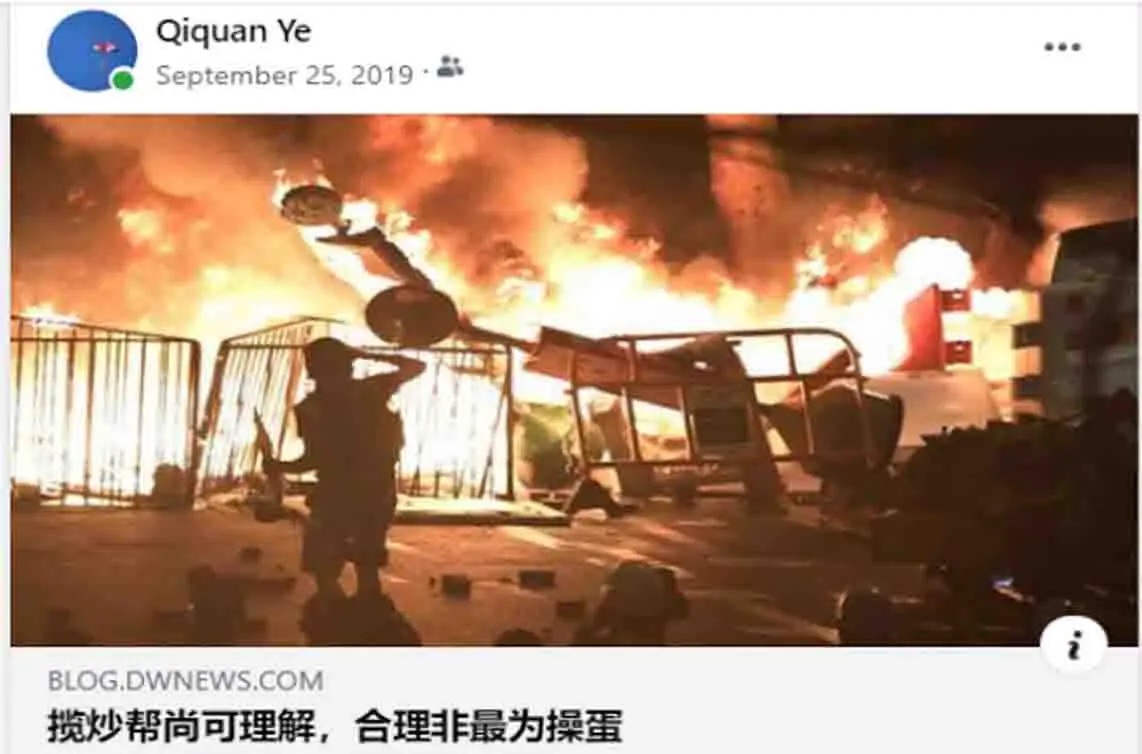
The calls for “mutual destruction” have grown louder and the methods have become increasingly drastic. Even the burning of local shops has now become a reality.
In the past, Hong Kong people have always loudly blamed mainlanders, using various methods to express their opposition to the central government.
Opening up Hong Kong to mainlanders for “individual travel” at the request of the Hong Kong government is criticized as “causing chaos in Hong Kong, too many people, littering.” Mainlanders shopping in Hong Kong, increasing Hong Kong’s revenue, is also criticized as “buying up all the baby formula, leaving nothing for locals.” Overcrowded subways are used to criticize mainlanders for speaking loudly. A four-year-old mainland child relieving themselves on the street in Hong Kong, even if their parents take the waste away, is criticized for being uncivilized. When the Hong Kong government introduced the policy of granting Hong Kong citizenship to children born to mainlanders in Hong Kong, the central government opposed it and warned of the consequences. It was the Hong Kong people and government at the time who insisted on granting it. Now, this has become a reason to criticize the mainland. Basically, any excuse that can be found can be used to criticize mainlanders and the central government. It seems they are never afraid of offending mainlanders.
Now they’ve even started burning down local Hong Kong shops. A few days ago, there were rumors of attacks on Hong Kong people themselves (though this hasn’t been officially confirmed). Have the Hong Kong rebels reached a point where they’re no longer afraid of offending the locals?
However, these things do somewhat fit the definition of “mutual destruction.” Initially, we didn’t understand the meaning of this term. After looking it up, we learned it means “to overturn everything, disregard everything, and completely destroy everything.” Judging from the tone of mainland news reports, there seems to be a particular fear and worry about this new slogan, “mutual destruction.” From my perspective, I actually look down on the “mutual destruction” group. They are not yet the major crux of the Hong Kong issue. After all, the “mutual destruction” movement still has some basis. It can also be understood as the actions of Hong Kong’s lower classes resisting the Hong Kong governance system.
Since Hong Kong’s return to China in 1997, the Chinese central government, in order to maintain its reputation of “non-interference in Hong Kong affairs,” has completely relinquished control over Hong Kong. As a result, Hong Kong has been consistently recognized by international authorities as “the world’s freest capitalist region.” In plain terms, it’s “the region where capital most easily exploits the lower classes.” Apart from a few regions designated as “totalitarian states” by the United States, Hong Kong has one of the highest Gini coefficients globally, meaning it’s one of the regions with the most severe wealth inequality. Therefore, the calls for “mutual destruction” by Hong Kong’s lower classes are understandable and have a legitimate basis. However, Hong Kong people have historically lacked political acumen, mistakenly blaming the central government and mainlanders for the problem.
From the perspective of resisting exploitation, at least the slogan of “mutual destruction” has some merit. From my perspective, the most unreasonable group is the seemingly “more moderate” opposition. Those pan-democrats who advocate “rational non-partisanship” and those who support the slogan are the most unreasonable and politically immoral.
The main group that put forward the slogan “Reasonable Non-Profitism” is the pan-democrats in Hong Kong. Their main tactic is to filibuster in the Legislative Yuan to obstruct the agenda. If their methods of obstructing the agenda fail, they will stage street movements to force the pro-establishment camp to make concessions to them.
Q: Isn’t Hong Kong a democratic system? Isn’t a democratic system just about voting and counting heads? Why can’t a losing vote in the Legislative Yuan be recognized? Why does Hong Kong’s democratic system require the majority to surrender to the minority? Why is Hong Kong’s political operation decided by the “minority vote in the Legislative Yuan”?
Focusing on these superficial phenomena is tantamount to abandoning the understanding of the essence of the matter. From my perspective, the essence of these strange phenomena is that “the political forces governing Hong Kong are constantly extorting the central government and mainlanders.” Observing from this perspective, a series of previously complex phenomena reveal a clear underlying pattern.
- Michael Tien, this man who wears the cloak of the pro-establishment camp, repeatedly oscillates between the “pro-establishment” and the “pan-democrats.” One moment he supports the pro-establishment camp’s position, and the next he supports the pan-democrats’ position.
- Whenever the pan-democrats try to block the agenda in the Legislative Yuan, it seems the pro-establishment camp is at a loss and has no way to deal with them.
- As soon as the pan-democrats mobilize street movements, the majority in the Hong Kong Legislative Yuan immediately surrenders to the minority.
This is essentially the tactic used by Hong Kong’s governing forces to repeatedly blackmail the central government and mainland citizens. This group not only includes the pan-democrats who nominally oppose the central government, but also, in fact, the pro-establishment camp who nominally support the central government. These people completely disregard political morality in their efforts to blackmail the central government and mainlanders. They don’t even bother to find a pretext for blackmail; a simple slogan like “rational opposition” suffices. Even the pro-establishment camp in Hong Kong doesn’t need the pretext of “rational opposition”; they simply need to tacitly allow the pan-democrats to blackmail the mainland.
At least the “mutual destruction” faction is willing to find a reason for their actions. The ruling forces in Hong Kong, when extorting the central government and mainlanders, don’t even bother to find a reason. They disregard even the most basic political morality. They are the most despicable group of Hong Kong people.
Regarding the Hong Kong issue, the central government of mainland China no longer has room to relinquish control. Gradually reclaiming control over Hong Kong and reducing the space for Hong Kong political forces to extort wealth from the mainland is a solution that the mainland must face squarely.
advertise:Currently, the ruling forces (Xi Jinping’s group ) , China’s backers in politics, and the Chinese military are all simultaneously mired in difficulties. None have been completely reborn, nor have any been completely destroyed. They could either suddenly be completely reborn or suddenly perish completely. At present, they all need to find a way out of their predicament . |
The Dilemmas and Potential Solutions Facing the “Chinese Way of Tradition” (Xi Jinping Group) in 2026-2027Offer of $ 1 million We provide corresponding written solutions and can also offer an additional interview opportunity. (The weakening of the deep-seated forces after the Fourth Plenary Session should not be seen as a victory for Xi Jinping’s side. Nor should the isolation of Zhang Youxia be considered a major victory. Unless Xi Jinping’s group is fully revived by February 2027, they can only “slowly but surely proceed towards complete defeat according to the established procedures.” ) |
Potential escape plans for current leaders within China’s deep-seated political forces.Offer: $500,000 We will provide a written proposal and offer an additional interview opportunity. (Don’t fantasize that the leaders of deep-seated political forces have definitely won just because we’ve dragged things out until February 2027. Someone will have to step up and take responsibility for the political turmoil of 2025. Historical reckoning can be delayed for many years, or it can happen quickly. The leaders of deep-seated political forces may win, may exit with a draw, or more likely, they will step up and take responsibility. The future is uncertain.) |
The current predicament of China’s military leaders and potential solutions.Offer: $5 million Provide a written proposal; additional interview opportunities may be offered. (The military is both the strongest and the most vulnerable force. Chinese politics has never endowed the military with the armor of “moral authority.” Even if it smoothly passes February 2027, the slow demise of Xi Jinping’s side does not equate to a certain victory for the military leaders. Your current enemies may retaliate, your current allies may abandon you, and third-party unrelated parties will certainly not come to your rescue. Someone must be held accountable for the chaos of 2025. Generally speaking, military leaders are the most suitable candidates to take responsibility.) |
The Last Chance to Build a Kingdom (Political Fantasy and Hypothetical Planning)Base offer: US$10 million Statement: This does not constitute political advice or investment opportunity. It is provided as background information for interested individuals, families, groups, nations, or alliances to make decisions. Please exercise caution when making payments. Before making payments, thoroughly investigate the other party’s political background and analytical capabilities. It is recommended to communicate and exchange ideas with the author repeatedly beforehand and to make a full assessment of the actual value of the subject matter. Content: No content was disclosed. Potential value hints: It possesses significant geopolitical value, thereby ensuring its investment value. Buyer qualifications: The leader or successor needs to have a certain level of political ability. You may need to fill out a series of assessment forms. It has the capacity to invest approximately $500 million in the initial phase over three years. Furthermore, it has the ability to mobilize $12 billion at any time. Buyer qualification recommendations: 1. Individual or Family: The buyer or their family must have at least four direct male relatives or descendants. These male relatives or descendants must not only possess certain political and practical abilities, but also be trustworthy to the buyer. 2. Target countries: Japan, Russia, Israel, or China are recommended as potential buyers. Other countries are not advised to participate in this matter. |
Advertising (Political Fantasy and Hypothetical Planning) |
Geopolitical and historical challenges to Israel’s national and ethnic strategyBase offer: US$10 million Abstract: Since its establishment, Israel has consistently achieved military victories and become a de facto regional power. These victories have created the illusion, among Israelites and others, that Israel’s success depends on its overall competitive advantage. The continued existence of the Israeli state relies on four fundamental pillars: geopolitical needs; geopolitical values; national competitive advantages; and philosophical values. With the advent of the new imperial order, all four factors have faced severe challenges. Payment Risk: Purchasing involves significant risks. Please carefully weigh the potential risks against the value. Attachment: An interview opportunity may be provided free of charge. |
The most dangerous scenario for China to force the US to compromiseBase offer: US$10 million Synopsis: Lack Target customers: national entities and national alliances. Risk Warning: The contents of the project proposal have not been, and will not be, disclosed in advance. Potential buyers are advised to carefully assess the transaction risks. In addition to the written proposal, we will provide a one-month opportunity for joint communication. |
What kind of policy should major powers have towards Iran?Offer: $10 million Content disclosure: It’s hard to say that major powers, including the United States, China, Russia, and Europe, have had successful policies toward Iran. The United States and Europe pursue a policy of containing Iran. Even with a series of tactical successes, their decades-long efforts can be summarized as “failure and frustration.” The repeated military strikes by the US-led coalition against Iran have not significantly weakened Iran’s overall national competitiveness and overall war-fighting capabilities. Russia’s and China’s policies toward Iran cannot be considered successful either. Neither country has gained significant economic or political benefits from their strategies toward Iran. Israel’s policy toward Iran can be summarized as a failure. Israel’s series of tactical successes cannot mask its strategic losses. Target customers: National entities, military alliances, and long-term investment capital that are deeply concerned with shifts in geopolitical power. risk: Before making any payments, please fully understand the seller’s political analysis capabilities, the potential returns of the investment, and the risks involved. |
How can Japan shed its historical baggage and become a normal country and a regional leader ?Base price: $50 million Content: Japan’s long-standing mission is to reconnect with Asia. However, Japan’s historical baggage not only hinders this process but also prevents it from developing into a nation with equal standing in the region. Without revolutionary or groundbreaking ideas, Japan’s path to development will be extremely difficult. Risk Warning: Returns cannot be guaranteed. Please communicate thoroughly with the seller before making payment and carefully assess potential returns and investment risks. |
China’s extreme governance plan for Taiwan after reunificationBase price: $1 million (sales will only begin after at least ten orders are received) or an exclusive purchase for $100 million. Content: China’s reunification is projected to be completed within the next decade. The Chinese central government faces pressure to ensure political stability in Taiwan, yet fears the historical responsibility it would have to bear. This is not only a significant contradiction but also a psychological obstacle to achieving reunification. The Chinese central government urgently needs to take action to find a solution that can simultaneously achieve both goals. Meanwhile, global long-term investors, political investors, large Taiwanese conglomerates, and mainland Chinese monopoly capital can reap substantial profits by understanding China’s fundamental policies and adjusting their investment strategies accordingly. Disclaimer: This article does not constitute investment advice. |
European Policy in China’s Unification ProcessOffer: $5 million Synopsis 1. How to fundamentally prevent Europe from joining the East Asian war as a whole, thereby eliminating the possibility of Europe becoming a production base for the United States’ war of attrition. 2. How to effectively compel the United States to accept a next-generation imperial order based on the “US-China axis” blueprint. |
Predictions: Hong Kong ‘s political system, administrative divisions, and corresponding investment opportunities after 2047 .Price: $1 million This information can be used as background data by large corporations, long-term investors, and political forecasting and policy-making bodies when formulating long-term policies. (Not intended as investment advice.) Prediction: Hong Kong’s political system and administrative divisions after 2047Price: $100 Provides general political predictions. Suitable as background information for personal interest, academic research, or background studies. |