
Long-Term Forecasting Review: Political Forecasting and In-Depth Analysis, Volume 1, Issue 1, February 2026
Two words to sum up Hong Kong people: greedy and foolish.
Ye Qiquan
| First release date: | Tuesday, July 16, 2019 |
| Reference data element: (APA) |
| Ye Qiquan. (2026). Two words to summarize Hong Kong people: greedy and foolish. Political Prediction and In-depth Analysis. 2026. Volume 1 (1), 4-7. |
Abstract: Hong Kong people, having already acquired full legislative, judicial, and judicial powers, are attempting to “seize” “full executive power.” These three powers constitute the entire power framework of an independent nation. The Chinese central government cannot allow Hong Kong people, who are “politically incapable,” to seize national power. Reclaiming some of the powers previously granted to Hong Kong people is the only possible option for the Chinese central government. The Hong Kong people’s “rebellion” will not only fail to achieve its intended benefits but will also jeopardize the maintenance and continuation of “one country, two systems” in Hong Kong, and will also jeopardize the prospects of “one country, two systems” in Taiwan.
Keywords: Hong Kong; demonstrations; universal suffrage; long-term prospects; one country, two systems;

Hong Kong people are not bad people. I have had a favorable impression of Hong Kong people on an individual level for many years. This stems from my first impression of Hong Kong people.
In 1999, on my first trip to Hong Kong, I couldn’t get off the subway and had to ask a man in his fifties for directions. He was also in a hurry, but he actually turned back and led me to the intersection I needed to go. From then on, I had a very good impression of Hong Kong people. Later, I met many Hong Kong people in my work environment. Some of them became friends, some for longer periods, some for shorter ones—but that’s another story.
However, when I try to get a general assessment of Hong Kong people, I prefer to use two very crude words to describe them: “greedy” and “foolish.”
Hong Kong people are economically driven; the word “greedy” isn’t necessarily derogatory to them. Without the pursuit of wealth, life would lose its meaning for them. For Hong Kong people, “greed” is a way of life. That’s easy to understand. However, whether their greed will ultimately bring them the benefits they expect is another matter entirely.
In Chinese dictionaries, two words are closely related to “greed”: “filth” and “corruption.” “Greed” is not associated with “gain” or “profit.” The word associated with “gain” is “sacrifice.”
“Willing to give up” and “corruption” are both historical terms in Chinese. They have been appearing in dictionaries for over a thousand years.
Ten or twenty years ago, Li Ka-shing was still an idol in the hearts of Hong Kong people (unlike now). I remember him saying something back then. The gist of it was: if something can generally earn 10 cents, he only needs to earn 7 cents.
From the current political climate, the mindset of most Hong Kong people conflicts with the philosophy of earning 7 cents. If something can earn 10 cents, Hong Kong people now aspire to earn 12 or even 15 cents. This is the most fundamental reason why Hong Kong has reached its current state.
Hong Kong people’s current hostility towards the mainland, opposition to the central government, and attempts to achieve Hong Kong independence with the backing of the British and Americans can only be described in one word: “foolish.” The root of this “foolishness” is “greed.” To greedily pursue something completely impossible can only be described as “foolish.” Being both greedy and foolish perfectly describes the current state of Hong Kong people.
1. Let’s start from the beginning. In 1997, the 99-year lease on the New Territories expired. Unless the central government renewed the lease with the British, the British had no bargaining power. There was only one word: “Return.”
The only area we can discuss is Hong Kong Island and the Kowloon Peninsula, which together comprise less than 5% of the island’s area. Take a look at the map.
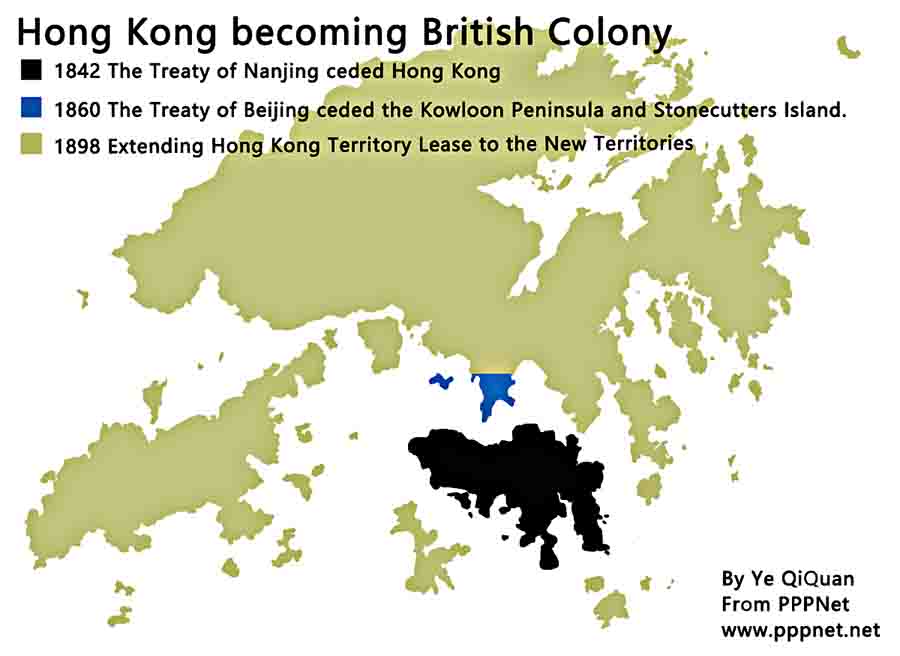
- If the central government had only offered less than 5% of the territory for negotiation, could the British have resisted? Could the people of Hong Kong have resisted? Could the capitalists of Hong Kong have resisted?
- To negotiate this tiny piece of land, less than 5%, the central government handed over the entirety of Hong Kong to the people of Hong Kong to manage themselves, to Hong Kong capitalists to manage. Have the people of Hong Kong ever thanked the central government? Have they ever thanked the people of mainland China?
- Now let’s discuss the facts of what some Hong Kong people say about “the British giving Hong Kong democracy, freedom, and dignity.”
- The plague is native to Europe. It was Europeans who brought it to Hong Kong. The first plague outbreak in Hong Kong in 1894 killed over 2,000 people. One-third of Hong Kong’s population fled. In the following 30 years, Hong Kong experienced several major plague outbreaks, resulting in over 20,000 deaths. (Important: over 20,000 deaths; those in Hong Kong who value human rights should remember this number.)
- More importantly, all 20,000-plus deaths were Chinese. Not a single British person died. This was because they all lived in the mountains, where Chinese people were not allowed to live. It wasn’t until many years later that permission was granted for one Chinese person to live in the mountains. Moreover, this Chinese person was not actually Chinese; his true identity was Portuguese. Today, Hong Kong people who emphasize dignity, freedom, and democracy must remember this fact.
- In the past in Hong Kong, all land plots approved for real estate development had to be selected by the British first. Land rejected by the British became available for the Chinese to compete for. That’s why the iconic buildings lining Hong Kong’s main streets all bear British names. (Today, when Hong Kong people emphasize dignity, they should remember this fact.)
- Regarding Hong Kong’s freedoms, even today’s Hong Kongers who oppose the central government and demand democracy and freedom must admit that “the British never granted Hong Kongers freedom.” Until the 1970s, Hong Kong was governed by the British through a few rogue Chinese police officers. The numerous films about “former police officer Reno” still popular in Hong Kong today reflect this historical context. Even after the establishment of the Independent Commission Against Corruption (ICAC), triad forces remained a major force in Hong Kong’s social governance. Hong Kong’s bus routes, sand factories, roadside night stalls, food stalls, and cinemas were all managed by triads. This group fled Hong Kong in 1997, later returning after failing to make it abroad. (Hong Kongers who emphasize democracy and freedom must review this history.)
- The transformation of Hong Kong’s Legislative Council from an advisory body into a legislative body is nothing more than a scheme orchestrated by the British to counter the Chinese central government. From the British perspective, their actions are understandable. Confronting the Chinese government and seeking long-term benefits from it aligns with the political ethics of British politicians and is something they should do. However, for the people of Hong Kong, assisting the British and betraying their own country is morally unacceptable. On a smaller scale, it’s exchanging enormous long-term interests for small immediate gains. On a larger scale, it’s betraying the nation and its people—it’s treason, and it will incur historical condemnation.
- Did the British, the ancestors some Hong Kong people worship, ever teach Hong Kong people a “political lesson”? No. The survival logic of European empires was “might makes right.” After winning the Opium War, they ceded Hong Kong and Kowloon to China and leased the New Territories. When the Japanese invaded, they didn’t fire a single shot and ran away. Today, you Hong Kong people are rebelling with the support of the British. Do you have any hope of winning? Let me give you a “political lesson.”
- Let’s talk about Article 23. Macau, being a good student, successfully completed the “Article 23 legislation.” The central government immediately “lent” them a large area like Hengqin. This is an area equivalent to 1/29th the size of Macau.
- Now let’s return to the “Hetao Area”. Back then, to control the flooding of the Shenzhen River, Shenzhen straightened the river, leaving a large piece of land on the Hong Kong side. Because it was on the Hong Kong side, it was difficult for Shenzhen to manage. Logically, lending it to Hong Kong should have been a straightforward matter, but why didn’t the central government grant it to you? It’s because you were “mischievous”.
7. Now let’s continue explaining why you’re “stupid”.
-
-
- You won’t let us teach the new curriculum? Why? Don’t you want to be Chinese? You accepted being the Governor of Hong Kong, but you don’t want to be Chinese? Aren’t you asking for trouble? Aren’t you just asking for all of China to condemn you? If you do this, do you think the central government will dare to make even the slightest concession? Aren’t you afraid the central government will condemn them to death?
- Regarding the “Article 23 legislation,” the central government has given you free rein to draft Article 23 legislation, which at least allows you to gain some “operable boundary area.”
- Article 23 essentially gives the central government a way to covertly control Hong Kong. Now that you’re preventing the central government from having this power, aren’t you forcing it to use overt means to control you?
- You didn’t implement Article 23 legislation, and now you’re insatiably greedy, demanding universal suffrage. Universal suffrage isn’t a big deal; we could have given it to you. But what will you offer in exchange?
- Hong Kong now possesses “almost complete legislative power,” “de facto complete judicial power,” and “almost complete diplomatic power.” Now, not only do you disagree with the central government using Article 23 as a “covert tool” to govern you, but you also demand “universal suffrage.” You want complete executive power. With such “complete executive power,” “complete legislative power,” and “complete judicial power,” what kind of special administrative region is this? Just call it the “Hong Kong Country”! Is that even possible? The Chinese central government just took Hong Kong back from the British, and now it’s handing it over to you bunch of politically ignorant fools without asking for a single penny. Isn’t this even more traitorous than the Qing Dynasty?
- You might not believe me when I say you’re naive. Let me tell you about the actual situation of the two “your fathers” who are instigating you. The United States is a country where provinces (states) have a very high degree of autonomy. Do their state governments have independent judicial power? Do they have full judicial power? In the United States, there is only one federal judicial system. Each state is just a branch of the federal judicial system. Any local laws that are inconsistent with federal law have no priority. What about Hong Kong? Hong Kong has full judicial power and does not need to refer to the central government’s judicial mechanism. In the United States, once state-level judicial power conflicts with federal judicial power, the federal government takes over the judicial process without consultation. Similarly, the provinces in Canada and the counties in the United Kingdom do not have full judicial power. Hong Kong, you have full and supreme judicial power. Don’t you know that?
- Not only does Hong Kong now have a Court of Final Appeal, but it’s also effectively controlled by foreigners appointed by the British. In which country would this be acceptable?
- If the central government doesn’t return some of its judicial, adjudicative, and legislative powers, how can it possibly grant you full executive power? Even Quebec, which is so powerful, doesn’t dare ask the Canadian federal government for these things.
- When the judicial and trial systems of Hong Kong are completely in the hands of the British, you still demand complete executive power. Isn’t that tantamount to “snatching” Hong Kong and “giving” it to the British? If you can’t see this, do you think the people in the central government can’t see this either?
- Just a few days ago, I saw some arrogant Hong Kongers on a forum claiming that Hong Kong’s economic power could influence central government decisions. Wake up! Shanghai contributes over 600 billion yuan to the central government annually, yet it remains strong and prosperous. Hong Kong, you earn your own money and spend it as you please, and now you’ve made a mess of things, and you still have the nerve to complain about the central government interfering with your governance?
- Not only did the central government save Hong Kong when Soros attacked it, by not collecting your due taxes, but it also continuously provided you with policy support, giving you preferential rates on water and electricity. And yet you still rebel against the central government today. What are you doing if not asking for a beating?
- Furthermore, some low-IQ Hong Kong rioters, unable to find anything else to say, claim that the central government’s daily approval of 150 people to Hong Kong is one of the sources of chaos in Hong Kong. Let’s be rational; this is a procedure under the Quality Migrant Admission Scheme, okay? Even if you really want to nitpick, you can compare it to the Vietnamese boat people’s program. Back then, over 200,000 Vietnamese boat people were accepted by the British government despite opposition from the central government. Were boat people your ancestors? Did the boat people pay taxes to you? Shouldn’t these Hong Kong rioters come out and do some math on this?
- If Hong Kong people don’t return to reason today, have you ever thought about “how the central government should govern you?” and “what will be the fate of Hong Kong after 2047?”
-
- summary
“One Country, Two Systems” is dead. This is Hong Kong people’s own doing. Having already acquired full legislative, judicial, and adjudicative power, Hong Kong people still want to “seize full executive power.” This combination of powers constitutes the sovereignty of a completely independent nation. The Chinese central government cannot allow Hong Kong people to act so recklessly. It cannot allow Hong Kong people to engage in “treasonous” actions that harm the interests of the nation and its people. It cannot allow Hong Kong to become independent, whether nominally or in reality.
Taking back some of the powers previously granted to Hong Kong is certainly a plan that the central government is considering. If it doesn’t do this, the central government will inevitably be held accountable for “selling out the country.”
As for the British, I predicted 10 years ago that their short-term solutions would inevitably harm their long-term interests. If the British do not make significant revisions to their current policies, their defeat is unavoidable. Their political presence in Hong Kong could very well be terminated prematurely.
For Taiwanese people, the actions of Hong Kong people have already damaged Taiwan’s future. Taiwanese people’s opposition to “one country, two systems” is completely wrong. The problem now is that mainland China is opposing “one country, two systems.” It is ordinary people on the mainland who are opposing “one country, two systems.” For Taiwanese and Hong Kong people, your long-term interest lies in pursuing “one country, two systems,” not in opposing it.
The “one country, two systems” principle must be fought for by the people of Hong Kong and Taiwan themselves. Otherwise, it will elude them. The prerequisite for striving for “one country, two systems” is to convince the people of mainland China that they deserve it.
The British and Americans’ pursuit of short-term gains inevitably harms their long-term interests. Cooperation with the Chinese government, rather than confrontation, is already the historical trend.
[Note:]
The article was first published on both Canada Home Network and 51.ca. A video version of the same name was released on YouTube on August 19, 2019.
advertise:Currently, the ruling forces (Xi Jinping’s group ) , China’s backers in politics, and the Chinese military are all simultaneously mired in difficulties. None have been completely reborn, nor have any been completely destroyed. They could either suddenly be completely reborn or suddenly perish completely. At present, they all need to find a way out of their predicament . |
The Dilemmas and Potential Solutions Facing the “Chinese Way of Tradition” (Xi Jinping Group) in 2026-2027Offer of $ 1 million We provide corresponding written solutions and can also offer an additional interview opportunity. (The weakening of the deep-seated forces after the Fourth Plenary Session should not be seen as a victory for Xi Jinping’s side. Nor should the isolation of Zhang Youxia be considered a major victory. Unless Xi Jinping’s group is fully revived by February 2027, they can only “slowly but surely proceed towards complete defeat according to the established procedures.” ) |
Potential escape plans for current leaders within China’s deep political forcesOffer: $500,000 We will provide a written proposal and offer an additional interview opportunity. (Don’t fantasize that the leaders of deep-seated political forces have definitely won just because we’ve dragged things out until February 2027. Someone will have to step up and take responsibility for the political turmoil of 2025. Historical reckoning can be delayed for many years, or it can happen quickly. The leaders of deep-seated political forces may win, may exit with a draw, or more likely, they will step up and take responsibility. The future is uncertain.) |
The current predicament of China’s military leaders and potential solutions.Offer: $5 million Provide a written proposal; additional interview opportunities may be offered. (The military is both the strongest and the most vulnerable force. Chinese politics has never endowed the military with the armor of “moral authority.” Even if it smoothly passes February 2027, the slow demise of Xi Jinping’s side does not equate to a certain victory for the military leaders. Your current enemies may retaliate, your current allies may abandon you, and third-party unrelated parties will certainly not come to your rescue. Someone must be held accountable for the chaos of 2025. Generally speaking, military leaders are the most suitable candidates to take responsibility.) |
The Last Chance to Build a Kingdom (Political Fantasy and Hypothetical Planning)Base offer: US$10 million Statement: This does not constitute political advice or investment opportunity. It is provided as background information for interested individuals, families, groups, nations, or alliances to make decisions. Please exercise caution when making payments. Before making payments, thoroughly investigate the other party’s political background and analytical capabilities. It is recommended to communicate and exchange ideas with the author repeatedly beforehand and to make a full assessment of the actual value of the subject matter. Content: No content was disclosed. Potential value hints: It possesses significant geopolitical value, thereby ensuring investment value. Buyer qualifications: The leader or successor needs to have a certain level of political ability. You may need to fill out a series of assessment forms. It has the capacity to sustain initial investments (approximately $500 million) for three consecutive years. Furthermore, it has the ability to mobilize $12 billion at any time. Buyer qualification recommendations: 1. Individual or Family: The buyer or their family must have at least four direct male relatives or descendants. These male relatives or descendants must not only possess certain political and practical abilities, but also be trustworthy to the buyer. 2. Target countries: Japan, Russia, Israel, or China are recommended as potential buyers. Other countries are not advised to participate in this matter. |
Advertising (Political Fantasy and Hypothetical Planning) |
Geopolitical and historical challenges to Israel’s national and ethnic strategyBase offer: US$10 million Abstract: Since its establishment, Israel has consistently achieved military victories and become a de facto regional power. These victories have created the illusion, among Israelites and others, that Israel’s success depends on its overall competitive advantage. The continued existence of the Israeli state relies on four fundamental pillars: geopolitical needs; geopolitical values; national competitive advantages; and philosophical values. With the advent of the new imperial order, all four factors have faced severe challenges. Payment Risk: Purchasing involves significant risks. Please carefully weigh the potential risks against the value. Attachment: An interview opportunity may be provided free of charge. |
The most dangerous scenario for China to force the US to compromiseBase offer: US$10 million Synopsis: Lack Target customers: national entities and national alliances. Risk Warning: The contents of the project proposal have not been, and will not be, disclosed in advance. Potential buyers are advised to carefully assess the transaction risks. In addition to the written proposal, we will provide a one-month opportunity for joint communication. |
What kind of policy should major powers have towards Iran?Offer: $10 million Content disclosure: It’s hard to say that major powers, including the United States, China, Russia, and Europe, have had successful policies toward Iran. The United States and Europe pursue a policy of containing Iran. Even with a series of tactical successes, their decades-long efforts can be summarized as “failure and frustration.” The repeated military strikes by the US-led coalition against Iran have not significantly weakened Iran’s overall national competitiveness and overall war-fighting capabilities. Russia’s and China’s policies toward Iran cannot be considered successful either. Neither country has gained significant economic or political benefits from their strategies toward Iran. Israel’s policy toward Iran can be summarized as a failure. Israel’s series of tactical successes cannot mask its strategic losses. Target customers: National entities, military alliances, and long-term investment capital that are deeply concerned with shifts in geopolitical power. risk: Before making any payments, please fully understand the seller’s political analysis capabilities, the potential returns of the investment, and the risks involved. |
How can Japan shed its historical baggage and become a normal country and a regional leader ?Base price: $50 million Content: Japan’s long-standing mission is to reconnect with Asia. However, Japan’s historical baggage not only hinders this process but also prevents it from developing into a nation with equal standing in the region. Without revolutionary or groundbreaking ideas, Japan’s path to development will be extremely difficult. Risk Warning: Returns cannot be guaranteed. Please communicate thoroughly with the seller before making payment and carefully assess potential returns and investment risks. |
China’s extreme governance plan for Taiwan after reunificationBase price: $1 million (sales will only begin after at least ten orders are received) or an exclusive purchase for $100 million. Content: China’s reunification is projected to be completed within the next decade. The Chinese central government faces pressure to ensure political stability in Taiwan, yet fears the historical responsibility it would have to bear. This is not only a significant contradiction but also a psychological obstacle to achieving reunification. The Chinese central government urgently needs to take action to find a solution that can simultaneously achieve both goals. Meanwhile, global long-term investors, political investors, large Taiwanese conglomerates, and mainland Chinese monopoly capital can reap substantial profits by understanding China’s fundamental policies and adjusting their investment strategies accordingly. Disclaimer: This article does not constitute investment advice. |
European Policy in China’s Unification ProcessOffer: $5 million Synopsis 1. How to fundamentally prevent Europe from joining the East Asian war as a whole, thereby eliminating the possibility of Europe becoming a production base for the United States’ war of attrition. 2. How to effectively compel the United States to accept a next-generation imperial order based on the “US-China axis” blueprint. |
Predictions: Hong Kong ‘s political system, administrative divisions, and corresponding investment opportunities after 2047 .Price: $1 million This information can be used as background data by large corporations, long-term investors, and political forecasting and policy-making bodies when formulating long-term policies. (Not intended as investment advice.) Prediction: Hong Kong’s political system and administrative divisions after 2047Price: $100 Provides general political predictions. Suitable as background information for personal interest, academic research, or background studies. |