
Case Commentary: Political Forecasting and In-Depth Analysis, Volume 1, Issue 1, February 2026
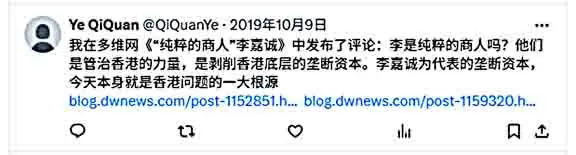
Monopoly capital, represented by Li Ka-shing, is a major root cause of the Hong Kong problem.
Ye, Qiquan
| First release date: | Wednesday, October 9, 2019 |
| Reference data element: (APA) |
| Ye, Qiquan. (2026). Monopoly Capital Represented by Li Ka-shing: A Major Root Cause of the Hong Kong Problem. Political Prediction and In-Depth Analysis. 2026. Vol. 1(1), 16-18. |
| Abstract: Li Ka-shing’s “Huangtai melon” advertisement was intended to extricate himself from the political turmoil and shirk responsibility. However, this advertisement is expected to bring unexpected consequences and have serious long-term effects. The Li Ka-shing family’s industrial capital will inevitably gradually withdraw from mainland China. This will also inevitably drive up the operating costs of the Li family’s capital in Hong Kong. The Li family will inevitably have to spend a significant amount of extra resources to rely on other political powers. In this process, the Li family’s power will inevitably gradually weaken. Once Li Ka-shing loses control of his capital, his capital group will inevitably rapidly split, fragment, and even disappear. |
There’s a rumor circulating online about Li Ka-shing’s “Huangtai melons” advertisement. I went online to check, and it turns out the ad has been out for a while. I only noticed it because someone wrote an article defending him. This shows that people in the online community don’t really care about the significance and consequences of this ad.
It’s quite obvious. Both the advertising slogan and the subsequent explanation clearly point to Li Ka-shing’s true intention in the advertisement: “Don’t blame me, I’m just a submissive wife. I can only suffer. All the blame can’t be placed on me.” The second half can be interpreted in many ways. First and foremost, it’s a criticism of the central government, meaning, “Hong Kong has already suffered enough; don’t put more pressure on it.” A second interpretation is, “I, Li Ka-shing, have been cautious and humble my whole life; I’ve already suffered enough. Don’t push me out to take the fall. I can’t do that anymore.”
Shifting blame is easy to understand; everyone has the instinct to seek advantage and avoid harm. However, Mr. Li may not have understood the destructive power of the latter part of his statement. Whether you blame the central government for being unfair to you personally or for being unfair to Hong Kong, the result is the same: you will inevitably break with the central government. You have lost the protection provided by the existing political forces.
Hong Kong people, including Li Ka-shing, are probably best at shirking responsibility. “The mistakes were all yours, it has nothing to do with me.”
Implementing “one country, two systems” in Hong Kong, simply put, means handing Hong Kong over to the people of Hong Kong to manage themselves. To put it even more bluntly, the central government has handed Hong Kong over to Hong Kong’s monopoly capital for management. You, Li Ka-shing and your ilk of monopoly capital, are the real “mothers-in-law” of Hong Kong! Where does this talk of “the melons on the vine” come from? Where does this talk of “the little daughter-in-law” come from?
During the British colonial era, you were truly the submissive wife, because with the Governor and the British government above you, land grants, land purchases, and housing in the Mid-Levels were all prioritized for the British. Weren’t you the submissive wife back then?
Now that Hong Kong is under your own control, why are you acting like a submissive daughter-in-law? The legislative power is exercised by the people of Hong Kong themselves. The judicial power is exercised by the people of Hong Kong themselves. Administration, capital taxation—all are handled by you, the people of Hong Kong. On the surface, it appears that Hong Kong is governed by the SAR government, but in reality, isn’t Hong Kong governed by monopolistic capitalists represented by you, Li Ka-shing? You’re not a submissive daughter-in-law; you’re the complete mother-in-law!
Let’s examine some of the world’s most authoritative indicators of government control over capital. In the highly regarded “Economic Freedom Index,” Hong Kong ranked first every year from 1997 to 2018. What does this mean? It means the government exerts the least restraint on capital, allowing for the greatest freedom of capital. In plain terms, it means capital can freely exploit profits without fear of government intervention. As Hong Kong’s largest monopolistic capitalist, who else but Li Ka-shing is the de facto ruler of Hong Kong?
One direct consequence of the greatest freedom of capital is the greatest wealth inequality. For 22 years after the handover, Hong Kong consistently had the most severe wealth disparity in Asia. The direct cause was the Hong Kong SAR government’s excessive indulgence of capital.
A huge wealth gap inevitably leads to social unrest. After reaping enormous profits, Hong Kong’s monopoly capital is now shirking responsibility, saying, “This is none of my business.” Then I ask, “Is it any of the central government’s business?”
Before the handover, Hong Kong’s monopoly capital received special treatment from the Chinese central government under the “two systems” principle. To accommodate the lifestyles of many Hong Kong residents, the central government entrusted the entire city to Hong Kong people, rather than just designating Hong Kong and the area south of Boundary Street as a special administrative region. As a result, in the more than 20 years since the handover, Hong Kong capital has never supported research on Article 23 legislation, nor has it ever supported any research on unification in universities. They are extremely sensitive to and oppose any tightening of control by the central government, as these measures would affect the extent to which they exploit the profits of ordinary people.
After creating an extremely severe wealth gap in Hong Kong, today’s Hong Kong monopoly capitalists are saying, “This is none of our business.” Not only that, they are also encouraging politically unsavory Hong Kongers to blame the central government, accusing it of causing Hong Kong’s problems. Li Ka-shing’s “Huangtai Melon” advertisement in Hong Kong is precisely such an attempt to shirk pressure and shift blame. However, this advertisement will likely have a completely unexpected backlash from Li Ka-shing.
Today, I’m not going to talk about the political quality of ordinary Hong Kong people. I just want to ask Li Ka-shing and the monopoly capital he represents in Hong Kong: have you thought about the consequences of shifting responsibility to the central government?
Taking you, Li Ka-shing, as an example, what are you referring to by saying “it’s too much to pick”? Are you accusing the “central government of exploiting Hong Kong,” or are you accusing the “central government of oppressing you”?
Whatever you’re referring to, it will have one clear consequence: a break between the central government and the Li family’s monopoly capital.
Financial power can take on many forms. However, at its core, it is a redistributive force. It inevitably intertwines with political power to maximize its function of wealth redistribution. It must also be combined with political power to generate profits most effectively. Today, the Li family is determined to sever a power structure that has been established for many years; tomorrow, its capital will inevitably have to pay the cost to find another possible political power framework. This is true all over the world, in the United States, and in the United Kingdom. Where will the Li family seek this “political-economic union” framework again? Europe and North America are two major potential destinations.
It is foreseeable that renewed investment will be necessary. Furthermore, Mr. Li Ka-shing’s age and health pose a significant risk to maintaining these political and economic ties. If his health falters, the costs he has incurred could be wiped out once again. Moreover, it is currently unclear whether his two sons can fully inherit his management skills and ability to cultivate political power. If his successors are unable to quickly rebuild an effective “political-economic integration structure,” the Li family’s vast business structure is likely to be difficult to maintain. The Li Group faces the risk of rapid fragmentation, disintegration, bankruptcy, or even annihilation.
Monopolistic capital, represented by Li Ka-shing, is itself a major root cause of the problems in Hong Kong today. Instead of proactively taking responsibility, it shifts the blame to the central government, inevitably leading to a price for Hong Kong’s monopolistic capital being severed from the Chinese central government.
| Verification of the prophecy:
Starting in 2021, Li Ka-shing’s companies began a large-scale sale of their businesses and assets in China. This sparked a wave of online discussion, with many arguing that “Li Ka-shing can’t be let go.” After a large-scale withdrawal from China, Li Ka-shing invested heavily in basic industries in the UK and other European countries. After 2024, rumors circulated online that Li Ka-shing intended to reinvest in mainland China. This information has not been verified, nor has the destination of the investment been confirmed. In 2025, it was rumored that Li Ka-shing’s company’s investment in the sale of a port was blocked by the Chinese government. The source, background, and consequences of this information have not yet been verified. |
advertise:Currently, the ruling forces (Xi Jinping’s group ) , China’s backers in politics, and the Chinese military are all simultaneously mired in difficulties. None have been completely reborn, nor have any been completely destroyed. They could either suddenly be completely reborn or suddenly perish completely. At present, they all need to find a way out of their predicament . |
The Dilemmas and Potential Solutions Facing the “Chinese Way of Tradition” (Xi Jinping Group) in 2026-2027Offer of $ 1 million We provide a corresponding written proposal and can also offer an additional interview opportunity. (The weakening of the deep-seated forces after the Fourth Plenary Session should not be seen as a victory for Xi Jinping’s side. Nor should the isolation of Zhang Youxia be considered a major victory. Unless Xi Jinping’s group is fully revived by February 2027, they can only “slowly but surely proceed towards complete defeat according to the established procedures.” ) |
Potential escape plans for current leaders within China’s deep-seated political forces.Offer: $500,000 We will provide a written proposal and offer an additional interview opportunity. (Don’t fantasize that the leaders of deep-seated political forces have definitely won just because we’ve dragged things out until February 2027. Someone will have to step up and take responsibility for the political turmoil of 2025. Historical reckoning can be delayed for many years, or it can happen quickly. The leaders of deep-seated political forces may win, may exit with a draw, or more likely, they will step up and take responsibility. The future is uncertain.) |
The current predicament of China’s military leaders and potential solutions.Offer: $5 million Provide a written proposal; additional interview opportunities may be offered. (The military is both the strongest and the most vulnerable force. Chinese politics has never endowed the military with the armor of “moral authority.” Even if it smoothly passes February 2027, the slow demise of Xi Jinping’s side does not equate to a certain victory for the military leaders. Your current enemies may retaliate, your current allies may abandon you, and third-party unrelated parties will certainly not come to your rescue. Someone must be held accountable for the chaos of 2025. Generally speaking, military leaders are the most suitable candidates to take responsibility.) |
The Last Chance to Build a Kingdom (Political Fantasy and Hypothetical Planning)Base offer: US$10 million Statement: This does not constitute political advice or investment opportunity. It is provided as background information for interested individuals, families, groups, nations, or alliances to make decisions. Please exercise caution when making payments. Before making payments, thoroughly investigate the other party’s political background and analytical capabilities. It is recommended to communicate and exchange ideas with the author repeatedly beforehand and to make a full assessment of the actual value of the subject matter. Content: No content was disclosed. Potential value hints: It possesses significant geopolitical value, thereby ensuring investment value. Buyer qualifications: The leader or successor needs to have a certain level of political ability. You may need to fill out a series of assessment forms. It has the capacity to invest approximately $500 million in the initial phase over three years. Furthermore, it has the ability to mobilize $12 billion at any time. Buyer qualification recommendations: 1. Individual or Family: The buyer or their family must have at least four direct male relatives or descendants. These male relatives or descendants must not only possess certain political and practical abilities, but also be trustworthy to the buyer. 2. Target countries: Japan, Russia, Israel, or China are recommended as potential buyers. Other countries are not advised to participate in this matter. |
Advertising (Political Fantasy and Hypothetical Planning) |
Geopolitical and historical challenges to Israel’s national and ethnic strategyBase offer: US$10 million Abstract: Since its establishment, Israel has consistently achieved military victories and become a de facto regional power. These victories have created the illusion, among Israelites and others, that Israel’s success depends on its overall competitive advantage. The continued existence of the Israeli state relies on four fundamental pillars: geopolitical needs; geopolitical values; national competitive advantages; and philosophical values. With the advent of the new imperial order, all four factors have faced severe challenges. Payment Risk: Purchasing involves significant risks. Please carefully weigh the potential risks against the value. Attachment: An interview opportunity may be provided free of charge. |
The most dangerous scenario for China to force the US to compromiseBase offer: US$10 million Synopsis: Lack Target customers: national entities and national alliances. Risk Warning: The contents of the project proposal have not been, and will not be, disclosed in advance. Potential buyers are advised to carefully assess the transaction risks. In addition to the written proposal, we will provide a one-month opportunity for joint communication. |
What kind of policy should major powers have towards Iran?Offer: $10 million Content disclosure: It’s hard to say that major powers, including the United States, China, Russia, and Europe, have had successful policies toward Iran. The United States and Europe pursue a policy of containing Iran. Even with a series of tactical successes, their decades-long efforts can be summarized as “failure and frustration.” The repeated military strikes by the US-led coalition against Iran have not significantly weakened Iran’s overall national competitiveness and overall war-fighting capabilities. Russia’s and China’s policies toward Iran cannot be considered successful either. Neither country has gained significant economic or political benefits from their strategies toward Iran. Israel’s policy toward Iran can be summarized as a failure. Israel’s series of tactical successes cannot mask its strategic losses. Target customers: National entities, military alliances, and long-term investment capital that are deeply concerned with shifts in geopolitical power. risk: Before making any payments, please fully understand the seller’s political analysis capabilities, the potential returns of the investment, and the risks involved. |
How can Japan shed its historical baggage and become a normal country and a regional leader ?Base price: $50 million Content: Japan’s long-standing mission is to reconnect with Asia. However, Japan’s historical baggage not only hinders this process but also prevents it from developing into a nation with equal standing in the region. Without revolutionary or groundbreaking ideas, Japan’s path to development will be extremely difficult. Risk Warning: Returns cannot be guaranteed. Please communicate thoroughly with the seller before making payment and carefully assess potential returns and investment risks. |
China’s extreme governance plan for Taiwan after reunificationBase price: $1 million (sales will only begin after at least ten orders are received) or an exclusive purchase for $100 million. Content: China’s reunification is projected to be completed within the next decade. The Chinese central government faces pressure to ensure political stability in Taiwan, yet fears the historical responsibility it would have to bear. This is not only a significant contradiction but also a psychological obstacle to achieving reunification. The Chinese central government urgently needs to take action to find a solution that can simultaneously achieve both goals. Meanwhile, global long-term investors, political investors, large Taiwanese conglomerates, and mainland Chinese monopoly capital can reap substantial profits by understanding China’s fundamental policies and adjusting their investment strategies accordingly. Disclaimer: This article does not constitute investment advice. |
European Policy in China’s Unification ProcessOffer: $5 million Synopsis 1. How to fundamentally prevent Europe from joining the East Asian war as a whole, thereby eliminating the possibility of Europe becoming a production base for the United States’ war of attrition. 2. How to effectively compel the United States to accept a next-generation imperial order based on the “US-China axis” blueprint. |
Predictions: Hong Kong ‘s political system, administrative divisions, and corresponding investment opportunities after 2047 .Price: $1 million This information can be used as background data by large corporations, long-term investors, and political forecasting and policy-making bodies when formulating long-term policies. (Not intended as investment advice.) Prediction: Hong Kong’s political system and administrative divisions after 2047Price: $100 Provides general political predictions. Suitable as background information for personal interest, academic research, or background studies. |