
| Chinese Politics | Political Forecasting and In-Depth Studies Vol 1 ( 3). Agu. 2026 |
Delaying China’s Unification: The U.S. Wins a Crucial Battle
Ye, Qiquan
Publication Date: Sunday, April 12, 2026
| Cite this article: (APA) | |
|
Ye, Qiquan.(2026). Delaying China’s Unification: The U.S. Wins a Crucial Battle. Political Forecasting and In-Depth Studies. Agu. 2026. Vol 1 ( 3). 1-17 .
|
|
| Abstract:
Multiple reports confirm that the leaders of the United States and China will hold a summit in mid-May 2026. This marks a victory for the United States in a critical campaign. Without investing excessive political resources, the U.S. has secured a strategic truce of approximately four years based solely on the arrangement of this summit. Due to the political groundwork laid for this summit and its subsequent political effects, the process of China’s unification with Taiwan has been postponed until at least 2029 or even later. This has secured the United States a critical four-year recovery period. The United States can use this window of opportunity to restore and even strengthen its overall war-fighting capabilities and national competitiveness. China, however, has been placed in a strategically passive position. It cannot be ruled out that China may permanently lose the historic opportunity to grow into a dominant empire.
|
|
| Key words: | |
| U.S.-China Summit; Imperial Order; China’s Unification Process; Empire-Building; U.S.-China Conflict; Critical Victory | |
Amid the chaos in the Middle East, the United States has quietly secured a decisive victory in a critical campaign. This victory guarantees the United States’ strategic security for at least four years.
The Middle East has long been a global hotspot; in fact, it has been engulfed in conflict for over a century, from before World War I to the present. Now, the eyes of the world are fixed on the situation in Iran and the Gulf. It appears that the wars in the Middle East are severely impacting the allocation of global political resources and the trends in the future shift of global political power.
For Israel and the Arab world, the wars in the Middle East are of vital importance. For the United States and China, however, the region holds far less strategic significance. For political observers worldwide, an excessive focus on the Middle East can severely distort their assessment of the global political landscape.
In this round of conflict with Iran, the United States does not appear to have achieved a strategic victory. Some even believe the U.S. has gotten itself into “trouble that isn’t worth the trouble.” Even within the U.S., a number of political observers are questioning American policy. Yet very few have noticed one thing: beneath the smokescreen of Middle Eastern chaos, the United States has already (not is currently, nor is about to) secured a crucial military victory. This victory ensures, at the very least, that the United States will not face any major strategic challenges over the next four years.
This victory is the summit-level meeting between the United States and China scheduled for mid-May of this year (2026). This meeting will effectively postpone China’s efforts to unify Taiwan until after 2029.
Regardless of whether the U.S.-China summit reaches an agreement, this strategic achievement has already been secured by the United States. Even if the U.S. and China were to have a major falling-out during this summit, this strategic success would still be solidified by the mere fact that the meeting was arranged.
I. China’s Unification Timeline
1.1. 2026: The Political Timeline of China’s Hardline Factions
Numerous political signals support the hypothesis that the political timeline of China’s hardline factions is to complete the unification of Taiwan by 2026. This is a prerequisite for Xi Jinping’s 20-year tenure in office. That is, Xi Jinping will fulfill his promise to unify the nation during his 20-year term. According to this timeline, Xi Jinping needs to launch the unification campaign in 2026, then lead the political arrangements for the 21st Party Congress, and step down from the center of the political stage in 2032.
1.2. Unification After 2027: Xi Jinping’s Political Arrangements
Xi Jinping does not deny the 20-year political arrangement, but he offers a different interpretation of it. As long as unification is completed before 2032, it does not violate the agreement regarding his “20-year tenure.” Therefore, he is doing his utmost to delay the unification process until after 2027. This would give him sufficient time to leverage his immense political prestige to ensure the continuity of his family’s political influence.
1.3. The Agenda of China’s “Moderate Faction”
It is evident that there is a powerful political faction in China that opposes the use of radical measures to unify Taiwan. Their stance stems from concerns about the risks posed by such radical approaches. While they support national unification in principle, they anticipate a “natural and organic outcome.”
1.4. The Stance of China’s “Democratic Faction”
Although mainland Chinese authorities vehemently deny the existence of political forces opposed to unification, international observers clearly acknowledge the presence of such a faction. This is a fact in China. This group believes that China’s current system of governance does not align with China’s long-term interests, and that Taiwan’s system, as a model, should not be destroyed. Preserving Taiwan’s system would be beneficial for the evolution of China’s political system.
1.5 Ye the Madman’s Hypothesis
Ye, Qiquan is called “Ye the Madman” by his friends. The reason is that he frequently makes “crazy political predictions.” And these predictions often come true. However, his predictions regarding Taiwan’s unification have faced failure.
Crazy Ye’s prediction in 2022 was that China would unify Taiwan in 2026. This is because 2026 represents the most favorable historical juncture for China to achieve unification. Missing this juncture could not only cause China to lose the opportunity to unify Taiwan but might even result in the permanent loss of the historical chance to grow into a dominant empire.
II. The Consistency Between the Xi Jinping Model and the Unification Model
A review of Xi Jinping’s 14-year governance model can be summarized by a single concept: the “preparation and execution of unification” governance model. The following facts support this hypothesis.
2.1 The Transition from Extreme Weakness to Extreme Strength
Until March 2012, Xi Jinping was consistently labeled as weak in China’s political arena. The following examples support this.
| Examples of Xi Jinping’s Weakness Before March 2012 | ||||
| Event | Background 1 | Background 2 | Background 3 | Significance |
| 2009: Delay in Appointing Xi as Vice Chairman of the Central Military Commission In 2009, | The outside world expected Xi Jinping to be appointed as Vice Chairman of the Central Military Commission at the Fourth Plenary Session of the 17th CPC Central Committee. | Spokesperson Cai Mingzhao responded, “This meeting did not discuss the appointment of the Vice Chairman of the Central Military Commission.” | Online rumors claimed that Xi Jinping himself had submitted a petition to the Central Committee “requesting a temporary postponement of his appointment as Vice Chairman of the Central Military Commission,” | Indicating that multiple forces were blocking Xi Jinping.
|
| Bo Xilai’s Rule in Chongqing During his tenure | Bo Xilai rose rapidly to prominence during his time in Chongqing, becoming a political star. He is widely seen as a challenger to Xi Jinping and a potential successor to Hu Jintao. | Six of the nine members of the Politburo Standing Committee personally visited Chongqing to inspect his work. | Among the high-ranking officials who inspected Chongqing were Xi Jinping—Bo Xilai’s political rival—and He Guoqiang, Bo Xilai’s overt political adversary. | The Jiang Zemin faction had explicitly endorsed Bo Xilai and compelled He Guoqiang and Xi Jinping to publicly support him. |
 |
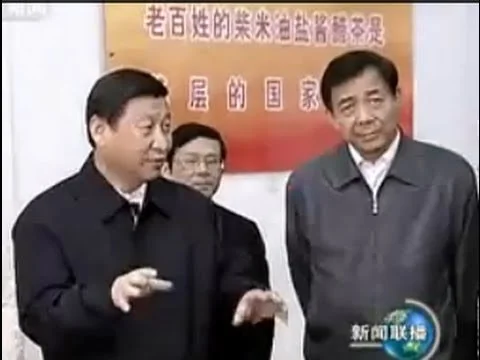 |
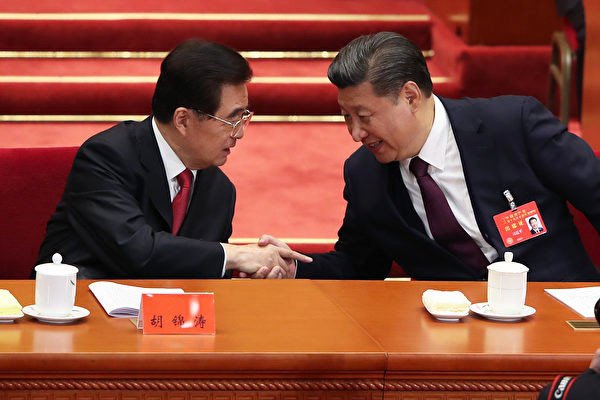
Two photographs clearly illustrate Xi Jinping’s attitude toward Bo Xilai and Hu Jintao prior to March 2012. They fully demonstrate Xi Jinping’s extreme weakness at that time.
This image of weakness was completely reversed after March 2012. Xi Jinping suddenly emerged on the Chinese political scene with a super-powerful stance. He directly issued a face-to-face challenge to the two most powerful political factions in China at the time. The following examples support this political hypothesis.
| Examples of Xi Jinping’s Direct Challenges to the Jiang Zemin and Hu Jintao Factions | |||
| Date | Event | Plain-Language Interpretation | Significance |
| March 27, 2012 | People’s Daily editorial “Don’t Leave Difficulties for Your Successor”
人民日报社论“别把难处留 后任” |
Please (referring to Hu Jintao) complete the trial of Bo Xilai before the end of your term. | Directly challenged the Hu Jintao faction (as a subordinate, directly ordering a superior official to complete a task);
directly challenged the Jiang Zemin faction (directly demanding the political elimination of a key figure in the Jiang faction) |
| May 2, 2012 | People’s Daily editorial “Don’t Back Down Before Stepping Down”
人民日报社论“离任之前别退火” |
Accuses Hu Jintao of being a coward who dares not sentence Bo Xilai to “political death.” | Significance as above |
| May 18, 2012 | People’s Daily editorial “Pave the Way Before Stepping Down”
人民日报社论“卸任之前铺好路” |
Instructed (ordered) Hu Jintao to complete the trial of the Bo Xilai case before leaving office. | Significance as above |
| From July to August 2012, | Numerous Party newspapers nationwide published a series of interview reports. The theme was “Complete this term’s work during this term; do not leave tasks for the next,”
主题是“本届的工作本届完成,不把工作留下任” |
Directly and publicly accusing Hu Jintao of shirking responsibility. These reports also publicly leveled accusations against Hu Jintao at the societal level. | Constituted a comprehensive and open challenge to both the Jiang Zemin faction and the Hu Jintao faction, demonstrating a determination to openly engage in a power struggle. At the same time,that implied that Xi Jinping had already taken early control of certain key state security agencies.
|
2.2 Relying on the Concentration of Political Power
A sudden shift from a position of extreme weakness to one of extreme strength necessarily required the backing of powerful political forces supporting Xi Jinping. At that time, apart from the Jiang Zemin and Hu Jintao factions, all other political forces in China were in a state of fragmentation. The only political mobilizing force capable of rapidly uniting these scattered factions was the most powerful political rallying cry: “national unification.” Xi Jinping’s ability to swiftly rally these fragmented political forces under his banner amidst a complex and chaotic situation was, in fact, the sole bargaining chip he possessed at the time. That was the completion of national unification.
2.3 Granted a 20-Year Term in Office
Ye, Qiquan posits a political hypothesis: China’s deep-seated political forces granted Xi Jinping a 20-year term in office. The condition of this arrangement was the completion of national unification during Xi’s tenure (Ye, Qiquan, March 4, 2023; March 19, 2023).
2.4 Establishing a War Mobilization System
Whether during the Jiang Zemin era or the Hu Jintao era, China was not a typical centralized system. The Hu Jintao era requires no elaboration; it was a system openly recognized as “nine dragons governing the waters.” Even a strong figure like Jiang Zemin was long constrained by the Ye Jianying, Li Ruihuan, Li Peng, and even Zhang Zhen families.
Xi Jinping, a political figure who was initially extremely weak, began openly consolidating power from the very start of his tenure. Under the slogan of “unifying authority under one leader,” China’s ultimate political decision-making power was fully entrusted to Xi Jinping. By establishing various “working groups,” he directly stripped the Premier of the State Council of his executive authority. Through amendments to the Party Constitution and the Constitution, he broke through the legal limits on the term of the President of the State. These measures collectively established a war preparedness system in China. In Chinese history, the extent of Xi Jinping’s centralization of power even surpasses that of Mao Zedong.
2.5 Directly Issuing a Mobilization Order for National Unification
In addition to building a series of war-preparedness systems, approximately one year after assuming the presidency, Xi Jinping publicly declared in Indonesia his intention to complete national unification during his term. Over the following two years, this message was repeatedly emphasized by Chinese officials.
III. Xi Jinping’s Success
Xi Jinping should not be dismissed as a failed politician merely because of his recent setbacks. At least until 2025, he can be counted among China’s most successful politicians. The following evidence supports this hypothesis.
3.1 Successfully Reversing the Trend of Fragmented Governance for the First Time
Since Mao Zedong’s death, China’s political leaders have never succeeded in centralizing power. This holds true for Hua Guofeng, Hu Yaobang, Zhao Ziyang, Jiang Zemin, and Hu Jintao alike. Even Deng Xiaoping, who enjoyed immense prestige, relied for a long time on a collective decision-making system involving the CCP’s elder statesmen.
3.2 Successfully curbing the rampant growth of powerful political clans
3.3. One of the very few examples of repeatedly rising from the political quagmire
In 2009, he announced he would “postpone assuming the post of Vice Chairman of the Central Military Commission”; from 2010 to 2012, he faced Bo Xilai’s aggressive offensive; on July 1, 2025, the announcement did not completely strip him of his “legitimacy”; in January 2016, he removed Zhang Youxia from military power. In Chinese history, the only comparable example of someone repeatedly falling and rising again is that of Emperor Xuanzong of Tang, Li Longji.
IV. Xi Jinping’s Failure
4.1 Self-Weakening of the Protection Provided by the Daoist Lineage
Many observers believe that Xi Jinping’s failure began with a series of unexpected events or missteps after April 2025. While these factors may exist, listing them as the primary causes is putting the cart before the horse.
Ye, Qiquan identifies Xi Jinping’s self-weakening of the protective forces of the Daoist tradition as the primary cause. He argues that Xi’s neglect of the protection afforded by these traditional forces is the fundamental reason for his failure.
In Chinese moral standards, the Mandate of Heaven—or the Daoist belief—is a sacred and unchangeable philosophical and moral constraint. Xi Jinping not only rallied China’s powerful political forces behind his promise to unite the country, but more importantly, he also won the support of the people by embracing the idea of the Mandate of Heaven, which is based on Daoist beliefs. This was the basis for Xi Jinping’s strict management of other political factions during the early years of his rule, and it was actually his greatest source of protection. As long as he stuck with the political idea of unification, no one dared to attack him because he could count on the political mobilization power from that idea to resist any political attack.
It is a fact that since the beginning of 2023, Xi Jinping and his faction have significantly toned down their rhetoric on unification. They have noticeably reduced the mobilization of calls for unification. This lull in mobilization has persisted, causing severe disappointment among grassroots forces, who even view him as having betrayed his political commitments, thereby causing him to lose his most powerful political protection. Ye Qiqian had already warned as early as March 2025 of the immense risks he might face (Ye Qiqian, March 4, 2023; March 19, 2023).
4.2 Lack of Top-Tier Advisors
Xi Jinping possesses extraordinary political skills and is laser-focused on his political objectives. These qualities have ensured his political success. However, on the other hand, these very qualities have hindered his ability to recruit top-tier political advisors. This shortcoming often leaves him facing failure with no one to assist him.
4.3 Closed-Door Operations
There are rumors going around that “loyalty that is not absolute is no loyalty at all.” This suggests that Xi Jinping’s inner circle has shifted towards a more closed-door approach, turning down any outside advice. In September 2025, Ye, Qiquan sent a mass email to China’s diplomatic system. It’s estimated that at least 600 people received the message. It looks like the idea that Xi Jinping’s inner circle should commit to rebuilding a deep, complex, and inseparable cooperative framework with the military was ignored. This led to the “isolation of Zhang Youxia” campaign in January 2026. This move totally cut off the Xi Jinping faction’s chance to rebuild ties with the military.
Tactically speaking, isolating Zhang Youxia was a remarkable political victory for the Xi Jinping faction. Strategically, however, it was the faction’s worst act of self-destruction.
4.4 Attempting to Establish a Family Dynasty Without Historical Merits
It is evident that since 2023, the Xi Jinping faction has reduced the intensity of its mobilization for unification. He has attempted to interpret the timeline for his 20-year tenure from his own perspective. If he unifies Taiwan after 2027, he will not only be able to dominate the composition of China’s power center in 2027, but he will also be able to legitimately dominate the political process after 2032. This would greatly increase his chances of establishing a family dynasty.
However, China’s deep-state political forces interpret the 20-year tenure rule as requiring Xi Jinping to complete unification before 2027, then dominate the political process from 2027 to 2032, and arrange for his exit after 2032. They emphasize this principle precisely to minimize the likelihood of Xi Jinping establishing a family dynasty.
4.5 Misunderstandings Regarding the U.S.-China Power Balance
In 2023, Chinese Foreign Minister Qin Gang was suddenly dismissed, followed by the public disclosure by some U.S. agencies of the coordinates and other details of China’s Rocket Force bases. Subsequently, the leadership of China’s Rocket Force underwent massive personnel changes. These may all be external factors that led the Xi Jinping faction to tone down its rhetoric on unification.
There is perhaps one possibility: that the Xi Jinping faction is overly fearful of U.S. military power. They were deeply alarmed by the U.S. release of information regarding China’s Rocket Force and developed significant doubts about their own total war capabilities.
Within the constraints of the current narrative framework, countless think tanks vigorously promote a narrative of power dynamics—namely, that China may approach U.S. levels of total war capability around 2050. This is not only a major factor influencing the Xi Jinping faction’s decision-making but may even serve as a benchmark model for China’s elite circles in assessing the total war capabilities of both China and the United States.
However, Ye, Qiquan analyzes the balance of power between China and the United States from the perspectives of overall competitiveness and empire-building. As early as 2022, he proposed a completely new narrative framework. From Ye, Qiquan’s perspective, China’s total war capabilities had already surpassed those of the United States by 2022. (Ye, Qiquan, 2023, 2025, 2026)
4.6 Misunderstandings Regarding the Need for Unification
Under the long-term influence of Western narratives, China’s elite and decision-making circles have inevitably developed significant misunderstandings regarding the conditions for unifying China. For example, they overemphasize the importance of existing military assets, overemphasize the influence of allied forces on the outcome of war, and harbor excessive fears regarding the consequences of disruptions to economic corridors, among other issues.
From Ye, Qiquan’s narrative perspective, China’s unification process relies heavily on several key factors. For instance: preventing Europe from becoming fully embroiled in a war in East Asia; relying primarily on the deterrent effect of short- and medium-range ballistic missiles rather than on the blocking role of aircraft carrier strike groups; the inability of U.S.-allied forces to land on Chinese territory, which establishes the foundation that China will not suffer a total defeat; expanding the nuclear arsenal to effectively prevent nuclear weapons from being used in war; and establishing contingency plans in advance to accommodate a potential shift in stance by Japan and South Korea during the course of the war; and so on.
4.7 Misunderstandings Regarding China’s Military Capabilities
Judging by the series of military restructuring measures Xi Jinping has rolled out since 2023, he harbors excessive anxiety regarding the military’s loyalty. The U.S. disclosure of Chinese Rocket Force data dealt a severe blow to Xi Jinping’s confidence. However, the impact of this U.S. disclosure might be explained from another perspective. Ye, Qiquan publicly proposed a strategy in 2023 suggesting that China could—and even should—deliberately disclose its strategic strike capabilities to influence European decision-making regarding involvement in a war in East Asia.
Additionally, Xi Jinping may be overly reliant on the influence of senior military officials regarding the course of the war. Indeed, from Ye Jianying and Deng Xiaoping through the Jiang Zemin and Hu Jintao eras, the issue of military loyalty has undeniably affected the government’s ability to act. However, one might consider the anxiety over loyalty during the unification process from a different angle: namely, that if the patriotic fervor of mid- and lower-ranking officers and ordinary soldiers is universally mobilized, the loyalty of the entire military will be fully guaranteed.
Xi Jinping might be making a mistake by not understanding how the Chinese military works and how it’s organized. After taking over as president, Xi got rid of the military region system and replaced it with a new theater command structure. This move shows that he relies a lot on senior military officials. But from Ye, Qiquan’s point of view, winning a big war shouldn’t count on the current top dogs in the military. Instead, it should be up to the mid-level or senior-mid-level officers to step up. This is because in every major war, the current high-ranking officials are almost always the group whose interests are harmed, whereas ordinary soldiers, mid-level, and senior-mid-level officers will be the groups that truly benefit from the war.
V. The Failure of China’s Hardline Political Forces
A cornerstone of Ye, Qiquan’s political hypothesis is that China’s deep political forces granted the Xi Jinping faction a 20-year term in office. The terms of this deal were that Xi must achieve national unification during his tenure. Their expectation was that Xi would complete unification before the 21st leadership collective is established, granting him the authority to form that collective and arranging an exit mechanism by 2032. This arrangement was designed as a set of checks and balances to prevent Xi from exploiting the achievements of unification to establish a hereditary dynasty.
Xi Jinping is a master manipulator of politics. He could interpret the 20-year timeframe as meaning that the unification process would begin after 2027. In this way, he could manipulate not only the composition of the 21st Chinese power collective but also that of the 22nd.
Based on the above assumptions, we cannot rule out the possibility that certain political forces in China are actively leaking intelligence regarding the Chinese Rocket Force to the United States. Relying on U.S. disclosures regarding the capabilities of China’s Rocket Force to delay the initiation of China’s unification process. Since the U.S. obtained China’s top-secret military intelligence, using this as a pretext to delay the unification process is a quite reasonable excuse.
Currently, there is no credible evidence to substantiate the true causes of China’s political turmoil in 2025. However, if this was a reactive maneuver by China’s hardline political forces, the operation has clearly failed, as it has further delayed China’s steps toward unification.
Regardless of the causes and the course of events, one outcome is clear: China’s unification process has been delayed. According to Ye, Qiquan’s hypothesis regarding the eight potential U.S. response options to China’s unification, the United States has successfully implemented its delaying strategy. Based on the arrangement reached between the United States and China to hold a summit in mid-May 2026, China’s unification efforts have effectively been postponed until 2029 or even later. Through this summit arrangement, the United States has secured at least four years of strategic breathing room.
VI. The United States’ Strategic Victory
From a historical perspective, the United States is inevitably confronted with the issue of China’s unification and the subsequent development and construction of a Chinese empire. According to the hypothesis established by Ye, Qiquan in 2022, the United States has eight distinct response strategies to address China’s unification. Among these, preemptive negotiations align most closely with U.S. long-term interests but are the most difficult to implement. Preemptive military containment holds the greatest military value, but its outcome is difficult to control and thus hard to implement. Another scenario favorable to the U.S. is the delaying strategy.
The delaying strategy involves using a series of complex political maneuvers to do everything possible to delay the process of China’s unification. This not only extends the U.S.’s tax collection period but also helps the U.S. weather its difficult period, allowing it to choose the most advantageous timing to address the China issue. The following events can be linked together to form the narrative of the U.S. implementing its delaying strategy.
In June 2022, Ye, Qiquan released the National War Power Index. China surpassed the U.S. to rank first in the index;
In July 2023, Chinese Foreign Minister Qin Gang was suddenly dismissed;
In July 2023, the U.S. released a document detailing the 2023 operational structure of the People’s Liberation Army Rocket Force;
From 2023 to 2024, a large-scale purge occurred among current and former senior leaders of the Chinese Rocket Force, the military equipment sector, senior officials in the aerospace and defense industry, and intelligence agencies related to military equipment, involving more than 20 high-ranking officials;
Starting in 2023, China significantly scaled back its propaganda efforts regarding unification;
In March 2025, at the height of Xi Jinping’s power, Ye, Qiquan released a vlog suggesting that Xi Jinping and his faction might face significant risks;
Online sources claim that in April 2025, Xi Jinping’s faction faced a political crisis; (Information to be confirmed)
On July 1, 2025, China publicly announced that the ultimate political decision-making authority had shifted from the Xi Jinping faction to an entity named the “Central Committee Decision-Making and Coordination Body.” China officially entered a period of political turmoil; however, the Xi Jinping faction retained nominal authority over the traditional political lineage.
After October 23, 2025, political reporting in China regarding “Spring Flowers and Autumn Fruits” noticeably cooled; China’s deep-state political forces suffered a major setback;
On January 24, 2026, Zhang Youxia was declared officially removed from the Chinese military; military leadership suffered a major setback;
In April 2026, the United States announced that it would hold a summit with China in May 2026; this marked the beginning of a strategic truce between China and the United States, lasting from that time until April 2029. It would be difficult for China to initiate a unification process during this period;
If the United States emerges from this fiscal crisis by January 2029 and its comprehensive national power increases, China may permanently lose the opportunity to unify Taiwan;
If the U.S. alliance establishes a comprehensive military superiority by April 2029, Taiwan may declare independence; or the United States may formally station troops in Taiwan, thereby creating de facto independence for Taiwan.
Following Taiwan’s de facto independence, China will permanently lose the opportunity to establish a new order in Northeast Asia, and China may permanently lose the opportunity to become a global leader. China may permanently lose the opportunity to become a dominant empire.
VII. The Risk of China’s Strategic Failure
7.1 The Significance of 2026 for China
The significance of 2026 for China has been mentioned repeatedly by Ye, Qiquan in other contexts (Ye, Qiquan, 2023; 2024; 2025). The table below briefly summarizes the evidence.
| The Importance of 2026 for China | |||
| Factor | Background | Effect | Importance Level |
| European Factor 1 | Europe has been formally expelled from the U.S. imperial power bloc since 2022. The U.S. cannot holistically coordinate Europe’s entry into the battlefield against China. | Europe cannot deploy its existing military forces to the Chinese (East Asian) battlefield. | ★★★
|
| European Factor 2: | China maintains an effective political advantage over Europe and can effectively prevent Europe from becoming a U.S. production base for attrition warfare. | Attrition warfare capability is the most critical factor ultimately determining the outcome of a Sino-U.S. war. | ★★★★★
|
| U.S. Factor 1: | The U.S. lacks an advantage in its existing military forces. | The U.S. cannot establish an overwhelming advantage over China in the early stages of the war. | ★★★
|
| U.S. Factor 2: | U.S. fiscal difficulties prevent the U.S. from entering a protracted war. | The U.S. lacks the financial capacity to sustain a full-scale war against China. | ★★
|
| U.S. Factor 3: | The U.S. is currently unable to restore effective attrition warfare capabilities; | it cannot muster sufficient political resources to establish attrition warfare bases in Europe. | ★★★★★ |
| Japan and South Korea Factor 1: | The risk of war failure prevents Japan and South Korea from becoming the U.S.’s primary attrition warfare production bases; | U.S. fiscal difficulties hinder strategic risk-taking plans, making it difficult for Japan and South Korea to serve as significant attrition warfare bases for the U.S. | ★★★
|
| Japan and South Korea Factor 2: | The U.S. cannot prevent Japan and South Korea from adopting a wait-and-see attitude; | the fear that South Korea and Japan might shift their focus to China during the mid-war period will hinder U.S. war decision-making and cast uncertainty over the war’s ultimate outcome | ★★★★
|
| Russia Factor 1: | The U.S. cannot muster sufficient political resources to bring Russia into an alliance with the U.S. | Political pressure on Russia in Europe is a key factor preventing Europe from venturing into the East Asian theater | ★★★★★
|
| Russia Factor 2: | Historical trends prevent Russia from joining a U.S.-Europe-Russia alliance; | the U.S. cannot expend significant political resources to reverse this trend | ★★★
|
| Russia Factor 3: | In attracting Russia, China holds a low-cost, high-value advantage to counter the efforts of Europe and the United States to court Russia. | Eliminating the risks from the north was an important diplomatic task for China in initiating its unification process. | ★★
|
| Table compiled by: Ye, Qiquan / PPPNet | |||
7.2 Risks to China from Wasted Opportunities
Similarly, the risks to China from wasted opportunities have been articulated by Ye, Qiquan on multiple occasions. The table below briefly outlines these risks.
| Risks to China from Wasted Opportunities | ||||
| Factor | Background | Risk Level | Potential Solutions | Probability of Achievement |
| Failure to launch reunification in 2027 | 2027 is a major election year in China, and the primary focus that year will be preparing to establish China’s 21st leadership core. | ★★★★★ | China’s three major political factions rapidly reach a compromise and launch unification in 2027 | 10%; possibly even lower |
| Failure to launch unification in 2028 | 2028 is the first year of the new leadership collective’s tenure; normalizing operational procedures will take time | ★★★★ | A political genius emerges from China’s deep political forces who can rapidly normalize the regime’s operational procedures | 20% |
| Unification cannot be launched in 2029 | Once the new power core develops disagreements over the plan and details of the unification process, unification will inevitably fail to officially launch in 2029. | ★★★★ | If the next power core maintains effective centralization, this issue can be resolved. | 50%
|
| The U.S. Escapes Its Fiscal Crisis | Given the U.S.’s history of creating the dot-com bubble, the likelihood of creating a new bubble is very high. | ★★★ | As long as China maintains a level-headed attitude toward the AI bubble movement, it can slow down or even stifle the U.S.’s “deification” campaign. | 70% |
| The U.S. Escapes Its Economic Crisis: | The U.S. cannot escape the crisis through production. The only solution lies in creating a bubble. | ★★ | The U.S. cannot mobilize Europe, Japan, and South Korea to join the “deification” campaign. | 50% |
| Establishment of a U.S.-Europe-Russia Mechanism: | This poses the greatest political threat to China. The probability of its realization is not low, provided the U.S. identifies the key leverage points. | ★★★★★ | China must face this reality head-on and develop a top-secret contingency plan to prevent this scenario from materializing. | 20%
|
| The U.S. Shifts Its Strategic Focus to East Asia: | Once the U.S. successfully establishes a “Europe-Russia” power mechanism in Europe, it will be able to invest in this political initiative. | ★★★★ | This is not an immediate threat; it requires a certain timeline and process | (10%)
|
| The U.S. establishing a new tripartite mechanism | It would be a plan to completely bury China’s imperial ambitions. | ★★★★★ | If China loses this historic opportunity to build an empire, it will inevitably become a permanent tax base and economic colony of the U.S. empire | 20% |
| Table compiled by: Ye, Qiquan / PPPNet | ||||
Discussion:
For China, the unification of Taiwan is an essential step in launching the process of building an empire.
For the U.S., it’s crucial to deal with historical trends and come up with the best national policies. In the past, China has been the main country challenging the U.S. imperial order. China’s challenge to the U.S. imperial order is already a reality and will only get worse. On top of that, China’s been slowly but surely taking U.S. taxing authority away, so U.S. global tax revenues aren’t covering the costs of its global governance (Ye, Qiquan, 2026). That’s a big reason why the U.S. is in such a mess right now. The U.S. still has the chance to choose the model for the next generation of imperial order (Ye, Qiquan, 2026). But if the new imperial order waited a bit, it could be good for the U.S. One strategy to delay the new imperial order is to do everything possible to slow China’s unification efforts.
It is evident that the United States is currently successfully implementing its “delay strategy.” A recently released report serves as strong evidence of this political hypothesis.
The United States recently announced that a U.S.-China summit will be held in mid-May 2026. No matter if the summit goes as planned and the U.S. achieves its goals, the U.S. has already won a key tactical victory. The summit’s schedule is the reason why China missed the chance to kick off the national unification process in 2026. The following year, 2027, is a big election year in China. During that time, all political factions will try their hardest to compete for the formation of the next power center. China missed the boat on its chance to start unification efforts in 2027. In 2028, the new power center won’t be able to start unification efforts until the regime is running smoothly. This means China won’t be able to unify in 2028 either. In 2029, even if the new power center decides to start unification efforts, it’ll probably have to deal with disagreements about plans, direction, and details. The truth is, starting unification in 2029 is still pretty far-fetched.
The United States has effortlessly secured a four-year strategic truce without investing significant political resources. This is a major victory for the United States. The U.S. can use these four years to restore its overall war-fighting capabilities and overall competitiveness. China may consequently find itself on the defensive and may even permanently lose the opportunity to build an empire.
Summary:
There are a lot of reports that the leaders of the United States and China are going to have a summit in the middle of May 2026. This is a big win for the United States. The U.S. got a four-year strategic truce without spending a lot of political resources, and it’s all based on this one summit. Because of the political work that went into getting ready for this summit and the effects it will have on politics, China’s plan to unify Taiwan has been put on hold until at least 2029, or maybe even later. This has given the U.S. a really important four-year recovery period. The U.S. can use this chance to boost its war capabilities and national competitiveness. But China’s in a pretty defensive position now. It’s possible that China could miss out on the chance to become a dominant empire.
References
Ye Qiqian. (2023). China’s Unifying Plan :(1) Shaped by 2012, Works in 2026. PPPNet. Mar. 29, 2023. https://eng.pppnet.net/chinas-unifying-plan-1-shaped-by-2012-works-in-2026/ .
Ye Qiqian. (2023). National War Intensity Model, with a Forecast on the Course of the War in Ukraine. PPPNET. Dec. 7, 2023. https://pppnet.net/nation-war-strength-model-and-prediction/ .
Ye Qiqian. (2025). A2a2: Why not in 2027 ? (PC). YouTube. Mar. 4, 2025. https://youtu.be/JbznRtpSWWY?si=8f2hibk8bC9SVlce .
Ye Qiqian. (2025). 02a3 Risks on Xi Jinping at Delayed unification(First published on 19 March 2025) . YouTube. Sep 20, 2025. https://youtu.be/Ss9BqaPf-jE .
Ye, Qiquan. (2025). Mathematical Model to Predict Wars. Saudi J. Humanities Soc. Sci. 2025. Vol. 10 (5). 243-256.
Ye, Qiquan. (2026). 2022 Nation War Strength Rankings. Political Forecasting and In-Depth Studies. April 2026. Vol. 1(2), 72–80.
Ye, Qiquan. (2026). “The Decline of the Imperial Order” from the U.S. Perspective. Political Forecasting and Insights. August 2026. Forthcoming.